• Skip to primary navigation
  • Skip to main content
  • Skip to primary sidebar
  • Libraries
    • Academic Libraries
    • Government Libraries
    • National Libraries
    • Public Libraries
  • Companies (Publishers/Vendors)
    • EBSCO
    • Elsevier
    • Ex Libris
    • Frontiers
    • Gale
    • PLOS
    • Scholastic
  • New Resources
    • Dashboards
    • Data Files
    • Digital Collections
    • Digital Preservation
    • Interactive Tools
    • Maps
    • Other
    • Podcasts
    • Productivity
  • New Research
    • Conference Presentations
    • Journal Articles
    • Lecture
    • New Issue
    • Reports
  • Topics
    • Archives & Special Collections
    • Associations & Organizations
    • Awards
    • Funding
    • Interviews
    • Jobs
    • Management & Leadership
    • News
    • Patrons & Users
    • Preservation
    • Profiles
    • Publishing
    • Roundup
    • Scholarly Communications
      • Open Access

New Report From EveryLibrary Institute: “Library Patron Privacy in the Age of Artificial Intelligence”

New Report From EveryLibrary Institute: “Library Patron Privacy in the Age of Artificial Intelligence”

May 12, 2026 by Gary Price

From EveryLibrary Institute:

As libraries across the United States rapidly adopt artificial intelligence tools and digital services, longstanding assumptions about patron confidentiality are being tested in new and urgent ways. “Library Patron Privacy in the Age of Artificial Intelligence” is an analysis examining how existing state library privacy laws intersect with emerging AI technologies, third-party data practices, and the realities of modern digital library services.

Produced by Lucie Daignault, Samuel Lim, and Catherine Ferri of the Georgetown University Communications and Technology Law Clinic in collaboration with the EveryLibrary Institute, this report surveys all fifty states and the District of Columbia to assess how current library patron privacy laws may or may not protect readers, researchers, and library users in the AI era. The paper explores the implications of generative AI, data retention, vendor relationships, digital circulation systems, and the growing tension between technological innovation and the constitutional and ethical obligations libraries have long upheld.

The paper includes a detailed, state-by-state, contemporaneous survey of state laws intended to inform librarians, trustees, policymakers, researchers, advocates, technologists, and anyone concerned with the future of intellectual freedom and privacy. The paper is designed to help start and deepen conversations across the library, legal, civic technology, and public policy communities. The rapid evolution of artificial intelligence requires libraries and their partners to think proactively about privacy, confidentiality, free expression, and the role of trusted public institutions in a data-driven society.

Direct to Full Text Report
(61 pages; PDF)

Filed Under: Data Files, Digital Collections, Interactive Tools, Journal Articles, Libraries, News, Patrons and Users

New Journal Article: “Artificial Intelligence (AI) and Information Seeking: A Comparative Exploration of AI Chatbots, Search Engines, and Library Resources as Information Sources Among University Students”

May 12, 2026 by Gary Price

Ed. Note: Many thanks to Sage for removing the paywall and allowing infoDOCKET to share the full text of this article. 

The article linked below was recently published by the Journal of Librarianship and Information Science.

Title

Artificial Intelligence (AI) and Information Seeking: A Comparative Exploration of AI Chatbots, Search Engines, And Library Resources As Information Sources Among University Students

Authors

Brady D. Lund
University of North Texas

Zoe Abbie Teel
University of North Texas

Yara Mohammed
University of North Texas

Abhignya Jagathpally
University of North Texas

Ting Wang
Emporia State University

Source

Journal of Librarianship and Information Science

DOI: 10.1177/0961000626143848

Abstract

Generative artificial intelligence (AI) tools like ChatGPT hold the capacity to tremendously impact patterns of information seeking behavior in higher education, as students rely on AI tools for a variety of tasks in their daily life. This study examines the current state of how U.S. university students perceive and use AI chatbots versus traditional online search engines and academic library resources for academic information seeking and retrieval tasks. Based on an understanding of information seeking concepts drawn from existing information behavior research and theory, an electronic survey was distributed to 236 students from diverse demographic backgrounds, measuring information source use, preference, perceived relevance, and satisfaction across AI tools, search engines, and library databases. The results of the survey suggest that, while search engines like Google remain dominant for information retrieval in higher education, generative AI tools are an increasingly significant component of students’ information worlds. Younger students and international students are especially likely to use AI for academic tasks. Students who are frequent AI users also report higher satisfaction in the information supplied by AI models. These findings are indicative of a shifting ecology of information behavior where artificial intelligence serves both as a complement and a competitor to traditional information sources like search engines and university libraries, presenting important implications for information literacy instruction, academic library services, and educators navigating AI integration in higher education.

Direct to Full Text Article

Filed Under: Academic Libraries, Libraries, News, Patrons and Users

Ontario: “Breaking Down the Ottawa Public Library’s Rebrand and Its Numbers”

May 11, 2026 by Gary Price

From the Ottawa Citizen:

Amidst a decline in physical book rentals and in-person visits to its 33 branches, the Ottawa Public Library is doubling down on a rebrand. One that positions it as a “third space” for clients.

In its 2025 end-of-year report, the Ottawa Public Library (OPL) said the last year was spent laying the groundwork to approve and move forward with its new brand, which was officially unveiled in January this year.

This move is meant to go “beyond visual identity,” according to Orléans East-Cumberland Coun. Matthew Luloff, who is also board chair for the OPL.

[Clip]

The rebrand is meant to bring to life the core values of the library, which is to go beyond the books and to build a sense of community by being “a third space”, according to Luloff’s message in the report.

[Clip]

But what has prompted this identity rebrand? The OPL’s 2025 end-of-year report provides an interesting insight.

In 2025, the OPL reported a decrease in physical borrowed books and in-person visits from the year before, while web-related activities saw a spike.

There was a total of 3.5 million in-person visits to OPL branches in 2025, a one per cent decline from 2024. Similarly, physical items borrowed saw a four per cent decline to 7.9 million.

Meanwhile, website visits increased (13.8 million) by 19 per cent from 2024, with a nine per cent increase in borrowed eBooks and eAudiobooks (3.2 million) from the year before.

Learn More, Read the Complete Article

Filed Under: Libraries, News, Public Libraries

Report From Dagstuhl Seminar 25381: Open Scholarly Information Systems: Status Quo, Challenges, Opportunities

May 11, 2026 by Gary Price

Event Page

Title

Open Scholarly Information Systems: Status Quo, Challenges, Opportunities

Authors

Hannah Bast, Guillaume Cabanac, Paolo Manghi, Jian Wu, and Marcel R. Ackermann

Source

Dagstuhl Seminar
DOI: 10.4230/DagRep.15.9.38

Abstract

Over the past 30 years, a rich ecosystem of scholarly information systems has developed that openly provide their services to the scientific community. These systems include aggregators of bibliographic metadata (e.g., DBLP, OpenCitations, OpenAIRE Graph, OpenAlex, ORKG, Semantic Scholar, CiteSeerX, and CORE); publication, data, and software repositories (e.g., Arxiv.org, Figshare, Zenodo, Software Heritage, and Dataverse); and PID authorities (e.g., ORCID, ROR, Crossref, and DataCite). This interdisciplinary Dagstuhl Seminar “Open Scholarly Information Systems: Status Quo, Challenges, Opportunities” (25381) was the first of its kind to bring together practitioners from this ecosystem, as well as researchers investigating related questions or relying on these systems in their own research. It provided a unique opportunity for dialogue, sharing insights, building new networks, and fostering collaboration.

Direct to Full Text
20 pages; PDF.

Publication Date: 2026-05-08

Filed Under: Data Files, News, Open Access

Report: “One in 277 PubMed-Indexed Papers In 2026 Shows Fabricated References, Says Analysis”

May 7, 2026 by Gary Price

From Retraction Watch:

Fabricated citations in the biomedical literature have increased 12-fold in two years, according to an audit of nearly 2.5 million papers published as a letter to The Lancet today.

The analysis of articles indexed in PubMed found that about one in 277 papers published in the first seven weeks of 2026 referenced a paper that didn’t exist. That was a jump from 2025’s rate of one in 458 and 2023’s one in 2,828. The researchers, led by Maxim Topaz of Columbia University’s Data Science Institute, used AI to “distinguish genuine fabrications from formatting discrepancies such as informally abbreviated titles.”

Topaz’s group located the sharpest increase in hallucinated references in mid-2024, which they note coincided with the rise of AI writing tools. The findings come as Nature reported last month that tens of thousands of publications from 2025 “might include invalid references generated by AI.” Retraction Watch has seen its fair share of reports of hallucinated citations generated by LLMs like ChatGPT.

[Clip]

Mohammad Hosseini, a researcher in biostatistics and informatics at Northwestern University’s Feinberg School of Medicine, called The Lancet analysis “simplistic.” In a March paper, Hosseini and Resnik made a point of distinguishing between hallucinated citations that matter to a paper’s scientific conclusions and those that do not. Topaz’s group didn’t differentiate scientifically critical references – which effectively function as data – from those that were relatively less important, Hosseini said.

Hosseini told us the study represents “low-hanging fruit” and the “tip of the iceberg.” He said the “bigger and more important problem” remains citations generated by AI that aren’t wholly hallucinated but are inaccurate, biased or incomplete. “We are far from being able to even detect them or do anything about them,” he said.

Learn More, Read the Complete Article (about 1290 words)

See Also: Fabricated Citations: An Audit Across 2·5 Million Biomedical Papers (via The Lancet;Volume 407, Issue 10541p1779-1781May 09, 2026)

Filed Under: Data Files, Journal Articles, News, Reports

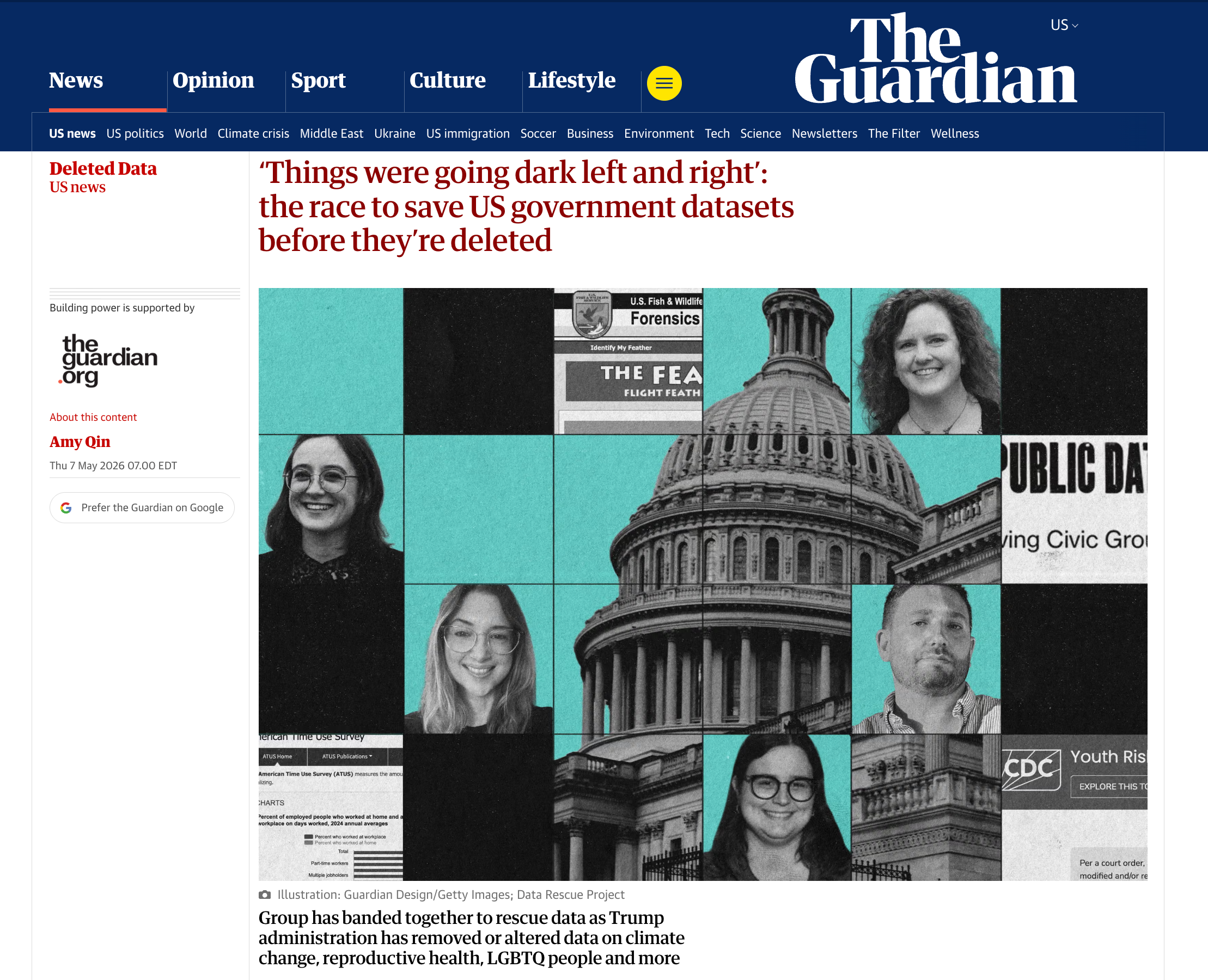
The Guardian: “‘Things Were Going Dark Left and Right’: The Race to Save US Government Datasets Before They’re Deleted”

May 7, 2026 by Gary Price

From The Guardian:

André is part of a group of “data rescuers” who’ve banded together during Trump’s second term. They’ve been quietly racing to save hundreds of critical government datasets before they’re no longer available. Now known as the Data Rescue Project, it’s a grassroots network of more than 800 people around the world who spend up to 40 hours a week painstakingly archiving the US government’s digital footprint in their spare time.

Anyone can join, but the majority of volunteers are librarians and academics, said Lynda Kellam, a university data librarian and a founding member of the Data Rescue Project. Programmers from the open-source software community and retirees also work on the project. Some, like André, contribute anonymously. What brings everyone together is the belief that “public data should be a public good”, said Kellam.

“We want people to recognize that this is a public good, just like roads and bridges and other kinds of infrastructure.”

[Clip]

 “It’s very much a social movement,” she  [Kellam] said, adding that there are now more than 20 groups and thousands of people advocating for public data in different ways, from the Internet Archive to the Environmental Data & Governance Initiative, which is documenting changes to federal environmental data and language with the help of webpages archived on the Internet Archive.

“We’re not going to have a million-person march on Washington on public data,” Kellam said. “But being able to get people interested in a topic that is somewhat nerdy and niche – I think we’ve been really successful with that.”

Learn More, Read the Complete Article (about 1100 words)

More From The Guardian

The Trump Administration is Deleting Government Data. From Infant Deaths to Hunger, Here Are 5 Ways It’s Hurting American

For decades, federal agencies have gathered data on everything from climate risk to the rising cost of childcare. It is information funded by taxes, and that belongs to the American people. This data is often how the government decides what to do: what is a problem, what is a policy priority, what should be funded. It tells the story of America.

But over the past year, the Trump administration has been altering and removing decades’ worth of datasets as part of a sweeping campaign targeting so-called “woke programs”, “racial equity”, “gender ideology” and “climate extremism”.

This censorship has affected not just datasets, but also a wide swath of federal resources: tools that helped the public access data, ongoing surveys and, perhaps most concerning, the agency staff that made it all possible.

Read the Complete Article, View Interactive Graphics

Filed Under: Data Files, News

  • « Go to Previous Page
  • Page 1
  • Page 2
  • Page 3
  • Page 4
  • Page 5
  • Page 6
  • Interim pages omitted …
  • Page 5178
  • Go to Next Page »

Primary Sidebar