• Skip to primary navigation
  • Skip to main content
  • Skip to primary sidebar
  • Libraries
    • Academic Libraries
    • Government Libraries
    • National Libraries
    • Public Libraries
  • Companies (Publishers/Vendors)
    • EBSCO
    • Elsevier
    • Ex Libris
    • Frontiers
    • Gale
    • PLOS
    • Scholastic
  • New Resources
    • Dashboards
    • Data Files
    • Digital Collections
    • Digital Preservation
    • Interactive Tools
    • Maps
    • Other
    • Podcasts
    • Productivity
  • New Research
    • Conference Presentations
    • Journal Articles
    • Lecture
    • New Issue
    • Reports
  • Topics
    • Archives & Special Collections
    • Associations & Organizations
    • Awards
    • Funding
    • Interviews
    • Jobs
    • Management & Leadership
    • News
    • Patrons & Users
    • Preservation
    • Profiles
    • Publishing
    • Roundup
    • Scholarly Communications
      • Open Access

New Journal Article: “Students’ Artificial Intelligence (AI) Literacy: An Exploratory Study”

New Journal Article: “Students’ Artificial Intelligence (AI) Literacy: An Exploratory Study”

May 21, 2026 by Gary Price

Many thanks to Sage for allowing infoDOCKET to share the full text version of this article. 

Title

Students’ Artificial Intelligence (AI) literacy: An Exploratory Study

Authors

Mor Deshen
Ramat Gan Academic College, Israel
Bar Ilan University, Ramat Gan, Israe
l

Noa Aharony
Bar Ilan University, Ramat Gan, Israel

Source

Journal of Librarianship and Information Science
DOI: 10.1177/09610006261442178

Abstract

This research aims to uncover the factors that might be associated with higher education students’ Artificial Intelligence (AI) literacy. Understanding these factors is crucial, as it can lead to numerous benefits, such as preventing skill gaps and ensuring workforce adaptability. The study used quantitative methodology. One hundred ninety students responded to an online quantitative questionnaire. Measures include a demographic questionnaire, as well as established validated and reliable questionnaires including AI literacy scale, the personal trait of openness to experience, the cognitive appraisals of threat and challenge, and four sub-scales of AI Device Usage Acceptance (AIDUA): social-influence, hedonic-motivation, willingness to accept AI usage, and positive emotions toward AI. Students’ AI literacy correlated positively with their openness to experience, challenge, social-influence, hedonic-motivation, willingness to use, emotions toward AI, and Generative AI (GenAI) usage. The study also provided insights into gender and age differences. As AI literacy is a crucial factor in our professional and daily life, the current findings suggest opportunities for enhancing it through tailored educational programs that foster relevant personal traits, attitudes toward AI, and curriculum development in higher education. This study is significant as it explores the relationship between students’ AI literacy and various variables that have not yet been examined thoroughly, in the context of the rapidly evolving use of GenAI chatbots.

Direct to Full Text Article

Filed Under: News

OpenAIRE and Alien Intelligence Announce Partnership to Bring AI Agents to the OpenAIRE Graph

May 20, 2026 by Gary Price

From an OpenAire Post:

…AI is changing how research is discovered and used. A newer generation of systems, often called agentic AI, can reason across sources, plan tasks, follow relationships between entities, and support decisions based on structured evidence. For open scholarly infrastructures, this raises a clear question: can the systems that increasingly interpret scientific knowledge be grounded in open, transparent, community-governed sources rather than in opaque content of unknown origin?

To work on this,OpenAIRE has partnered with Alien Intelligence (Alien AI), a startup building agentic AI systems that interact with structured knowledge environments.

The collaboration combines two things. OpenAIRE brings the OpenAIRE Graph, a community-governed scholarly infrastructure with more than 350 million research products linked to researchers, organisations, funders, projects, datasets, software, and publications. Alien Intelligence brings the agent layer that can navigate these connections and turn them into usable answers.

The result is a direct connection between autonomous AI agents and the OpenAIRE Graph. Instead of relying on general web content or text prediction alone, agents can work with authoritative scholarly metadata, persistent identifiers, and verified relationships between research entities. Every answer can be traced back to its source in the Graph.

Paolo Manghi, OpenAIRE CTO, and Ghislain Delabie of Alien Intelligence describe the work as a commitment to trustworthy AI, addressing the two persistent issues in AI-driven research:

  • Transparency. Each result carries a clear record of where in the Graph it came from.
  • Quality. The Graph is rebuilt regularly, with deduplication and validation of ORCID and ROR identifiers, so the agents are not working from noisy or unverified data.

Learn More, Read the Complete Post

Filed Under: Data Files, News

Association of American Publishers (AAP) Releases StatShot Report For First Quarter, 2026: Overall Industry Was Up 0.9%; Professional & Scholarly Publishing Up 5.7%

May 18, 2026 by Gary Price

From the Association of American Publishers (AAP): 

Today, the Association of American Publishers (AAP) released its StatShot report covering the first three months of 2026 reflecting reported revenue for Trade (Consumer Books), Education (combines PreK-12 Instructional Materials and Higher Education Course Materials), and Professional & Scholarly Publishing.

Total revenues across all categories for the first quarter of the year were up 0.9% as compared to the first three months of 2025, coming in at $2.9 billion.

Trade (Consumer Books) Revenues for First Quarter of 2026

Trade (Consumer Books) sales were up 0.2% during the first three months of the year, coming in at $2.2 billion. Within the Trade category, books for adults decreased 0.5% to $1.5 billion compared to the first three months of 2025 while books for children and young adults increased 2.6% to $560.7 million.

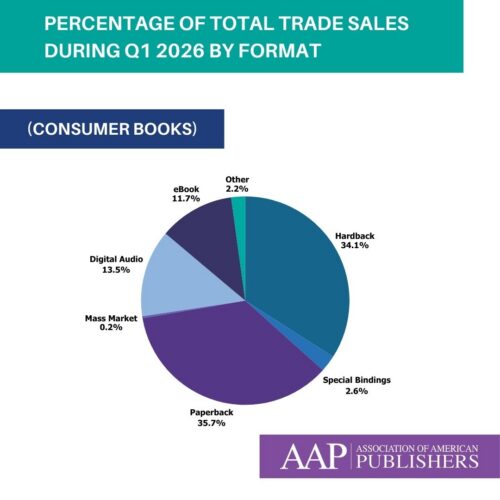
In terms of physical paper format revenues during the first quarter, in the Trade (Consumer Books) category, Hardback revenues were down 6.5%, coming in at $760 million; Paperbacks were up 4.2%, with $796.2 million in revenue; Mass Market was down 75.6% to $5.2 million; and Special Bindings were up 21.6%, with $57.4 million in revenue.

eBook revenues were down 5% as compared to the first three months of 2025, for a total of $261 million. Digital Audio was up 15.9% for the first three months, coming in at $302.3 million in revenue. Physical Audio was down 11.4%, coming in at $1.3 million.

Trade (Consumer Books) Revenues by Month
January

Trade (Consumer Books) sales were down 4.5% in January, coming in at $754.8 million. In terms of physical paper format revenues during the month of January, in the Trade (Consumer Books) category, Hardback revenues were down 11.3%, coming in at $263.1 million; Paperbacks were up 0.3%, with $272.3 million in revenue; Mass Market was down 68.5% to $3.6 million; and Special Bindings were down 3.4%, with $19.6 million in revenue.

eBook revenues were up 3.6% at $85.2 million for the month, and revenues from the Digital Audio format were up 5.9% for January, coming in at $94.1 million in revenue. Physical Audio revenues were down 32.1%, coming in at $500 thousand.

February

Trade (Consumer Books) sales were up 5.9% in February, coming in at $758.9 million. In terms of physical paper format revenues during the month of February, in the Trade (Consumer Books) category, Hardback revenues were up 5%, coming in at $256.1 million; Paperbacks were up 7%, with $254.6 million in revenue; Mass Market was down 85.3% to $900 thousand; and Special Bindings were up 18%, with $18.2 million in revenue.

eBook revenues were down 13.1% at $90.9 million for the month, and revenues from the Digital Audio format were up 27.9% for February, coming in at $117.2 million in revenue. Physical Audio revenues were up 16.8%, coming in at $400 thousand.

March

Trade (Consumer Books) sales were down 0.4% in March, coming in at $722.4 million. In terms of physical paper format revenues during the month of March, in the Trade (Consumer Books) category, Hardback revenues were down 11.5%, coming in at $240.9 million; Paperbacks were up 5.7%, with $269.3 million in revenue; Mass Market was down 80.5% to $700 thousand; and Special Bindings were up 70.2%, with $19.6 million in revenue.

eBook revenues were down 5.9% at $82.8 million for the month, and revenues from the Digital Audio format were up 13.4% for March, coming in at $91 million in revenue. Physical Audio revenues were up 1.4%, coming in at $400 thousand.

Religious Presses Down 1.4% First Quarter of 2026

Religious press revenues were down 1.4% during the first three months of 2026, coming in at $219.6 million. Hardback revenues were down 4.3% to $130.2 million in revenue, Paperback revenues were up 1.3% to $42.4 million, eBook revenues were up 0.5% coming in at $13.3 million, and Digital Audio revenues were up 2% at $12.5 million.

Professional & Scholarly Publishing Up 5.7% for First Quarter of 2026

Professional & Scholarly Publishing, including business, medical, law, technical, scientific, and other books were up 5.7% during the first three months of the year, coming in at $104.1 million.

Education Materials (combines PreK-12 Instructional Materials and Higher Education Course Materials) Up 3.2% for First Quarter of 2026

During January 2026, revenues from Education Materials were $211.1 million, down 4.8% compared with January 2025. In February, Education Materials revenues were $185 million, up 13.9% from February 2025. For March, Education Materials revenues were $113.7 million, up 3.4% compared with March 2025. Year-to-date Education Materials revenues were $509.7 million, up 3.2% compared to the first three months of 2025.

AAP’s StatShot

AAP StatShot reports the monthly and yearly net revenue of publishing houses from U.S. sales to bookstores, wholesalers, direct to consumer, online retailers, and other channels. StatShot draws revenue data from approximately 1,416+ publishers, although participation may fluctuate slightly from report to report.

StatShot reports are designed to give ongoing revenue snapshots across publishing sectors using the best data currently available. The reports reflect participants’ most recent reported revenue for current and previous periods, enabling readers to compare revenue on both a month-to-month and year-to-year basis within a given StatShot report.

Monthly and yearly StatShot reports may not align completely across reporting periods, because: a) The pool of StatShot participants may fluctuate from report to report; and b) Like any business, it is common accounting practice for publishing houses to update and restate their previously reported revenue data. If, for example, a business learns that its revenues were greater in a given year than its reports first indicated, it will restate the revenues in subsequent reports to AAP, permitting AAP in turn to report information that is more accurate than previously reported.

Filed Under: Companies (Publishers/Vendors), Data Files, Journal Articles, News, Publishing, Reports

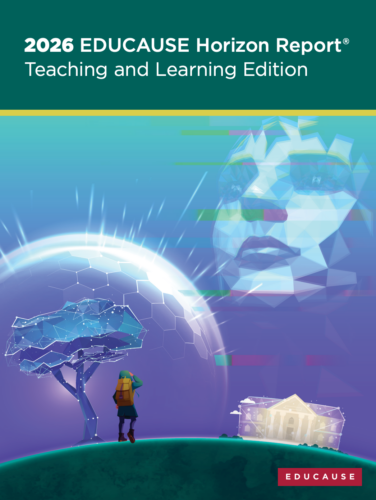
Just Released: 2026 EDUCAUSE Horizon Report | Teaching and Learning Edition

May 18, 2026 by Gary Price

From EDUCAUSE:

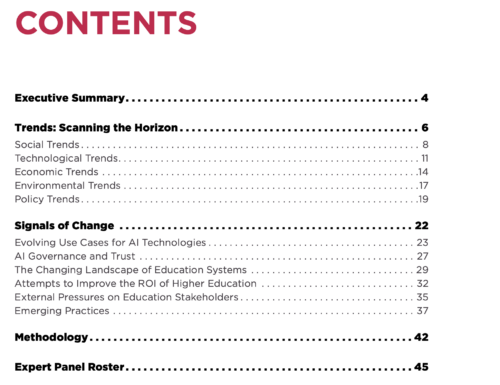
The 2026 EDUCAUSE Horizon Report | Teaching and Learning Edition identifies the most influential trends and early signals shaping higher education teaching and learning over the next decade.

Based on the work of an expert panel using the STEEP framework, the report highlights how artificial intelligence, enrollment pressures, policy shifts, and sustainability concerns are reshaping instructional practice and institutional strategy.

Report Resources

  • Full Text Report
    46 pages; PDF.

Direct to Sections of the Report

  • Executive Summary
  • Key Trends
  • Signals of Change

Direct to Podcast/Discussion

Filed Under: News, Podcasts

New From Ithaka S+R: US Library Survey 2025: Under Pressure

May 14, 2026 by Gary Price

US Library Survey 2025: Under Pressure was published today (May 14, 2026) by Ithaka S+R.

The report was written by Ellen Carroll, Tracy Bergstrom, and Ioana G. Hulbert,

From the Executive Summary:

Key Findings

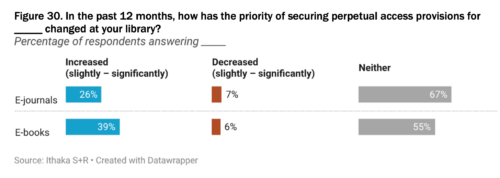
  • Leaders are operating under sustained financial and staffing constraints. Mirroring previous cycles, the majority of respondents cite a lack of financial resources as the primary constraint on their ability to make changes in their libraries. Anticipated cancellations of journal packages alongside reductions in staff mean that libraries are also limited in their ability to sustain core functions.
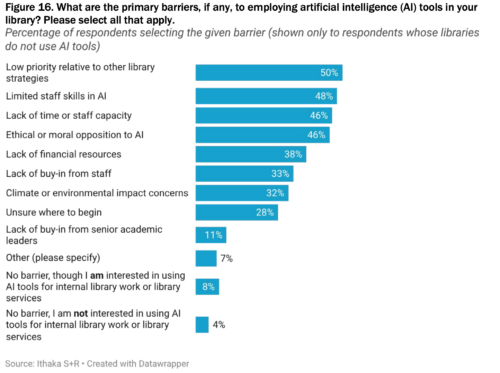
  • AI is reshaping priorities, but adoption remains uneven. Leaders anticipate increased demand for AI literacy instruction, staff reskilling, and research integrity safeguards. However, many libraries have not yet integrated AI into their internal operations, citing limited staff capacity or expertise, ethical concerns, and competing priorities.

  • While most leaders feel confident in their ability to articulate the library’s value proposition, fewer believe this value is recognized by senior administrators. Additionally, only 31 percent agree that they are involved in key decision-making processes at the campus level.
  • Student learning and information literacy are near-universal priorities, but confidence in impact lags. Nearly all leaders identify fostering student learning, promoting critical thinking, and supporting information literacy as core priorities. Smaller shares, however, express confidence in the library’s effectiveness or in its recognition as a campus leader in these areas.
  • Investments in open access initiatives have declined. Since the survey was last administered, the share of leaders prioritizing transformative agreements declined from 38 percent to 26 percent. The share prioritizing transitioning their spending from subscriptions to open investments also declined steeply from 45 percent to 23 percent.

  • Concerns about user data privacy are increasing. Half of leaders are concerned about third-party access to individual-level data, reaching the highest point since we first asked this question in 2019.
  • Roughly one-third of respondents plan to hire staff for AI and machine learning roles. Additional areas of expected growth include instruction and information literacy, assessment, student success, scholarly communication, and research data management.

Direct to Full Text Report 

Direct to Full Text Report (79 pages; PDF)

Filed Under: Data Files, Libraries, Management and Leadership, News, Open Access, Reports

Preservation: Library of Congress Adds 25 Recordings to the National Recording Registry; Selections Include Sounds by Taylor Swift, Beyoncé, The Go-Go’s, Vince Gill, Ray Charles, Chaka Kahn, Weezer, and Reba McEntire

May 14, 2026 by Gary Price

From the Library of Congress:

Taylor Swift’s transformative pop album “1989,” Beyoncé’s standout “Single Ladies (Put a Ring On It),” The Go-Go’s debut album “Beauty and the Beat,” Vince Gill’s signature “Go Rest High On That Mountain,” Weezer’s self-titled debut “Weezer (The Blue Album),” Chaka Khan’s crossover hit “I Feel for You,” and Broadway’s original cast album of “Chicago” have been selected as some of the defining sounds of history and culture that will join the National Recording Registry of the Library of Congress in 2026.

Acting Librarian of Congress Robert R. Newlen today named 25 recordings as audio treasures worthy of preservation for all time based on their cultural, historical or aesthetic importance in the nation’s recorded sound heritage.

The 2026 class of inductees span 70 years of music and recorded sound, including: The Byrds’ single “Turn! Turn! Turn! (To Everything There is a Season),” Reba McEntire’s defining country album “Rumor Has It,” Rosanne Cash’s album “The Wheel,” Gladys Knight and the Pips’ “Midnight Train to Georgia,” Ray Charles’ “Modern Sounds in Country and Western Music” and José Feliciano’s beloved Christmas classic “Feliz Navidad.” For the third time, video game music was selected with the soundtrack from Doom. Selected singles from the 1940s and 1950s include Paul Anka’s “Put Your Head on My Shoulder,” Kaye Ballard’s “In Other Words (Fly Me to the Moon),” Pérez Prado’s “Mambo No. 5,” and the earliest recording, “Cocktails for Two” by Spike Jones and His City Slickers from 1944.

“Music and recorded sound are essential, wonderful parts of our daily lives and our national heritage. The National Recording Registry works to preserve our national playlist for generations to come,” Newlen said. “The Library of Congress is proud to select these audio treasures and will work to preserve them with our partners in the recording industry.”

The public made more than 3,000 nominations of recordings to consider this year. Weezer was among the most nominated selections. The 2026 selections mark the first recordings by Swift and Beyoncé chosen for the registry. It also marks the first time a daughter and father have both been included in the registry with the selection of Cash’s “The Wheel.” Her father Johnny Cash’s “At Folsom Prison” was selected in 2003.

The recordings selected for the National Recording Registry this year bring the number of titles on the registry to 700, representing a small portion of the national library’s vast recorded sound collection of nearly 4 million items.

[Clip]

Listen to many of the recordings on your favorite streaming service. The Digital Media Association, a member of the National Recording Preservation Board, compiled a list of some streaming services with National Recording Registry playlists, available here: https://dima.org/playlist/national-recording-registry-class-of-2026/.

[Clip]

Recordings Selected for the National Recording Registry in 2026
(chronological order)

  • “Cocktails for Two” – Spike Jones and His City Slickers (1944) (single)
  • “Mambo No. 5” – Pérez Prado and His Orchestra (1950) (single)
  • “Teardrops from My Eyes” – Ruth Brown (1950) (single)
  • “Fly Me to the Moon (In Other Words)” – Kaye Ballard (1954) (single)
  • “Put Your Head On My Shoulder” – Paul Anka (1959) (single)
  • “The Blues and the Abstract Truth” – Oliver Nelson (1961) (album)
  • “Modern Sounds in Country and Western Music” – Ray Charles (1962) (album)
  • “Turn! Turn! Turn! (To Everything There Is a Season)” – The Byrds (1965) (single)
  • “Amen, Brother” – The Winstons (1969) (single)
  • “Feliz Navidad” – José Feliciano (1970) (single)
  • “The Fight of the Century: Ali vs. Frazier” (March 8, 1971) (broadcast)
  • “Midnight Train to Georgia” – Gladys Knight and the Pips (1973) (single)
  • “Chicago” Original Cast Album (1975) (album)
  • “The Devil Went Down to Georgia” – The Charlie Daniels Band (1979) (single)
  • “Beauty and the Beat” – The Go-Go’s (1981) (album)
  • “Texas Flood” – Stevie Ray Vaughan and Double Trouble (1983) (album)
  • “I Feel For You” – Chaka Khan (1984) (single)
  • “Your Love” – Jamie Principle (1986) / Jamie Principle/Frankie Knuckles (1987) (singles)
  • “Rumor Has It” – Reba McEntire (1990) (album)
  • “The Wheel” – Rosanne Cash (1993) (album)
  • “Doom” Soundtrack – Bobby Prince, composer (1993)
  • “Go Rest High On That Mountain” – Vince Gill (1994) (single)
  • “Weezer (The Blue Album)” – Weezer (1994) (album)
  • “Single Ladies (Put a Ring on It)” – Beyoncé (2008) (single)
  • “1989” – Taylor Swift (2014) (album)

Learn More, Read the Complete Release (Includes Info About Each Recording)

Additional Resources

See Also: National Recording Registry Website

See Also: National Recording Registry (All Entries)

See Also: Registry Titles with Descriptions and Expanded Essays

See Also: National Recording Preservation Foundation Website

See Also: National Jukebox

Filed Under: Libraries, News, Preservation

  • « Go to Previous Page
  • Page 1
  • Page 2
  • Page 3
  • Page 4
  • Page 5
  • Interim pages omitted …
  • Page 5178
  • Go to Next Page »

Primary Sidebar