• Skip to primary navigation
  • Skip to main content
  • Skip to primary sidebar
  • Libraries
    • Academic Libraries
    • Government Libraries
    • National Libraries
    • Public Libraries
  • Companies (Publishers/Vendors)
    • EBSCO
    • Elsevier
    • Ex Libris
    • Frontiers
    • Gale
    • PLOS
    • Scholastic
  • New Resources
    • Dashboards
    • Data Files
    • Digital Collections
    • Digital Preservation
    • Interactive Tools
    • Maps
    • Other
    • Podcasts
    • Productivity
  • New Research
    • Conference Presentations
    • Journal Articles
    • Lecture
    • New Issue
    • Reports
  • Topics
    • Archives & Special Collections
    • Associations & Organizations
    • Awards
    • Funding
    • Interviews
    • Jobs
    • Management & Leadership
    • News
    • Patrons & Users
    • Preservation
    • Profiles
    • Publishing
    • Roundup
    • Scholarly Communications
      • Open Access

After Rhode Island Victory, Connecticut Libraries Call on More States to Address Predatory E-Book Pricing (Statement by the Connecticut Library Consortium)

After Rhode Island Victory, Connecticut Libraries Call on More States to Address Predatory E-Book Pricing (Statement by the Connecticut Library Consortium)

June 12, 2026 by Gary Price

Here’s the Full Text of a Statement by the Connecticut Library Consortium:

The Connecticut Library Consortium (CLC) today congratulated Rhode Island lawmakers on passing legislation to address unfair e-book and audiobook licensing practices and called on additional states to pursue similar reforms.

Rhode Island’s action comes as libraries across the country continue to struggle under a digital licensing system that forces taxpayers to pay repeatedly for access to books they never truly own. Under current publisher licensing models, libraries can pay up to ten times the consumer price for a single e-book license and may be required to repurchase that same title after just 26 checkouts or two years to retain access.  For many libraries, the result is a growing share of digital materials budgets being spent simply replacing expired licenses rather than expanding collections, reducing wait times, or purchasing books by new and emerging authors.

“Rhode Island lawmakers looked at the facts and reached the same conclusion Connecticut lawmakers reached last year: the current system isn’t working for libraries, readers, or taxpayers,” said Ellen Paul, Executive Director of the Connecticut Library Consortium. “Libraries are paying more and more each year just to maintain access to the books people already want to read. That’s not sustainable for public institutions or the communities they serve.”

Connecticut enacted its own e-book legislation in 2025 after lawmakers concluded that existing digital licensing practices placed an unreasonable burden on libraries and taxpayers. The legislation was approved overwhelmingly by the General Assembly, passing 35-1 in the Senate and 106-38 in the House.

Rhode Island’s victory is particularly notable because it came after an unusually visible campaign by publishing interests, including public advertising, opinion pieces, and warnings that publishers could stop selling digital content to libraries in the state. Despite those efforts, Rhode Island lawmakers overwhelmingly determined that reform was necessary.

“It’s exciting to see Rhode Island and other states taking action after Connecticut passed our landmark e-book bill,” said State Representative Eleni Kavros DeGraw, House Chair of Connecticut’s Planning and Development Committee. “This legislation shows how unfair e-book pricing is to our libraries and to our taxpayers and we must stand as a united front against a multi-billion dollar industry.”

Library leaders emphasized that reforming digital licensing practices is not about harming authors. In fact, libraries argue that lower licensing costs would allow them to purchase more titles from more authors. Today, libraries often must devote significant portions of their digital budgets to repeatedly relicensing a small number of high-demand titles, leaving fewer resources available to discover and promote debut, local, and midlist authors.

Connecticut’s law was intentionally designed to encourage broader national action. It cannot take effect until additional states representing a combined population of seven million people enact substantially similar legislation. Rhode Island’s passage represents meaningful progress toward that goal, but additional states are still needed.

“Connecticut acted. Rhode Island acted. Other states are actively considering similar legislation,” Paul said. “The momentum is growing because the problem is real. Libraries should be able to invest in readers and collections, not spend taxpayer dollars repeatedly renting the same books from some of the largest publishing companies in the world.”

 

Filed Under: Companies (Publishers/Vendors), Funding, Libraries, News, Publishing

More Perfect and Urban Libraries Council (ULC) Select Eight Public Libraries Selected for Local News Partnership Project

June 10, 2026 by Gary Price

From an Urban Libraries Council Announcement:

Today, More Perfect, an American alliance dedicated to revitalizing democracy, and the Urban Libraries Council (ULC), an organization dedicated to strengthening libraries as dynamic civic institutions, announced that eight ULC members have been selected for a national pilot program to connect public libraries to local news organizations.

The program puts community members at the center of local journalism, creating opportunities for residents to shape the stories and information in their communities. The goal is for the eight libraries to develop replicable models for libraries to collaborate with local news.

The participating public libraries are:

  • Alameda County Library (CA)
  • Allen County Public Library (IN)
  • Anne Arundel County Public Library (MD)
  • Clayton County Library System (GA)
  • Kalamazoo Public Library (MI)
  • Pima County Public Library (AZ)
  • Sacramento Public Library (CA)
  • Saint Paul Public Library (MN)

The partnership between More Perfect and ULC works to leverage public libraries’ role as one of the most trusted, low-barrier, and welcoming civic spaces in American life to foster community engagement and well-being. Each library will participate in trainings and peer problem-solving focused on increasing access to and trust in reliable local information, strengthening community voices and narratives in local storytelling, and supporting civic dialogue.

“Libraries and newsrooms share a central civic function: helping residents understand their communities, navigate public systems, and participate in local democracy,” said Shamichael Hallman, Senior Director of Civic Health and Economic Opportunity at the Urban Libraries Council. “This pilot program teams local libraries and newsrooms to put residents at the center of local news, giving them a voice in the stories that affect their lives and communities. By combining library resources with newsroom expertise, we are creating a model for community-driven local news that can be replicated nationwide.”

“Public libraries and local newsrooms are two vital pillars of civic life, and we are proud of the progress this program has already made in bringing them together,” said John Bridgeland, Founder and CEO of More Perfect. “By connecting these eight libraries with local news organizations, we are ensuring that civic leaders become active shapers of the stories that define their communities. We believe this model will serve as a blueprint for renewing civic life across the nation.”

Brooks Rainwater, President & CEO of the Urban Libraries Council, added, “This initiative demonstrates the transformative power of libraries as civic conveners. By connecting libraries with local newsrooms and supporting collaborative, community-driven journalism, we are equipping residents with the tools to engage meaningfully in their communities, combat misinformation, and build stronger, more informed neighborhoods. We are excited with the diversity of ULC members featured, and proud to partner with More Perfect to pilot this innovative approach to civic engagement.”

Notably, the work will be advised by two veterans of the news industry, Samantha Ragland, Senior Vice President at American Press Institute, an experienced journalist, educator and digital strategist with more than fourteen years of experience including at USA Today, and Terry Parris, Jr., a John S. Knight Journalism Fellow and founder of the Library Newsroom Project with over 15 years of experience creating innovative, community-driven storytelling initiatives, including as Public Square editor for Headway, an initiative of the New York Times.

Filed Under: Associations and Organizations, Libraries, News, Public Libraries

Ithaka S+R Introduces a New LibGuide: Understanding the Environmental Impacts of Artificial Intelligence (New Research Resource)

June 9, 2026 by Gary Price

From a Post by Claire Baytas, Ithaka S+R:

As colleges and universities increase their adoption of artificial intelligence, and particularly generative AI, there is a parallel, rising need for AI literacy instruction. Since librarians are experts in information literacy and technology, they are often on the frontlines of providing training in AI literacy. Indeed, this is reflected in Ithaka S+R’s recently published 2025 US Library Survey, where academic library leaders were asked what they anticipate the most significant impacts of AI will be on their libraries. The most common answer, selected by 83 percent of respondents, was increased demand for AI literacy instruction.

[Clip]

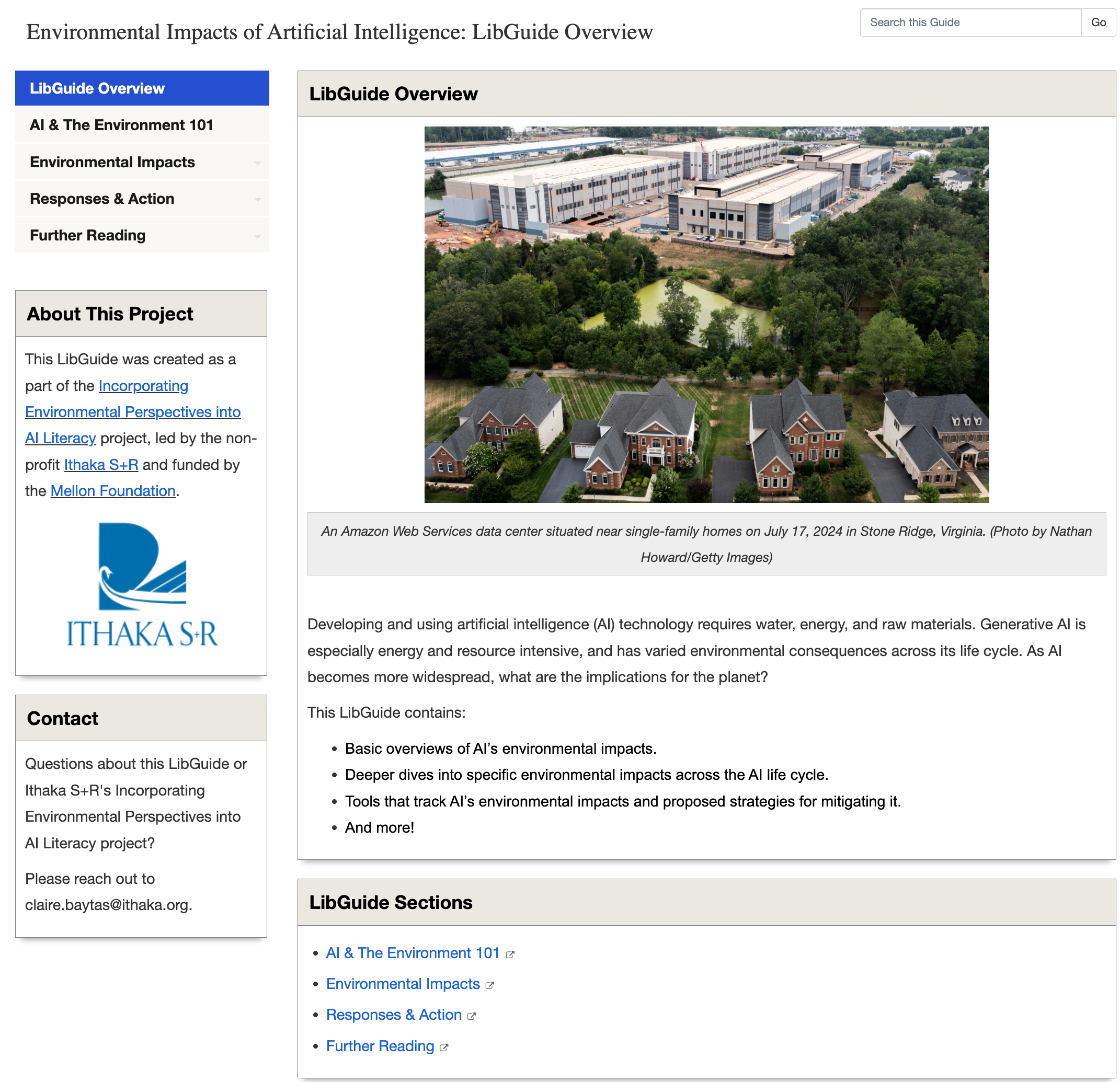
Today, we are publishing a LibGuide focused on the Environmental Impacts of AI, as a part of our Incorporating Environmental Perspectives into AI Literacy project, funded by the Mellon Foundation. The LibGuide’s objective is to help users attain a baseline understanding of the varied environmental consequences behind AI technology. The LibGuide’s articles, reports, podcasts, videos, data trackers, and other types of resources address environmental impacts throughout the AI lifecycle. These include energy and water use, emissions, mining, hardware construction, and e-waste, as well as resources about data centers and their effects. The guide also links to research on how AI could be developed more sustainably, tools that track AI’s environmental footprint, policy recommendations, and more.

The materials in the LibGuide reveal that researchers still do not have a full grasp of AI’s environmental impacts, and opinions vary on how to think about and act on information available to date. Research in this area is evolving rapidly, and estimates from different sources—whether for measurements of emissions, water or energy use, or other impacts—do not always align with each other. Major technology companies are also not always transparent about resource use and other environmental impacts. Despite these challenges, the resources included in the LibGuide document what we do know about the impacts of widespread AI adoption on the planet.

Direct to  Environmental Impacts of Artificial Intelligence LibGuide
Learn More, Read the Complete Post by Clare Baytas

Filed Under: Academic Libraries, Data Files, Libraries, News, Patrons and Users, Podcasts, Publishing, Reports

Report: House Votes to Take Over Librarian of Congress Appointment Power 

June 8, 2026 by Gary Price

From Roll Call:

House lawmakers passed a bill Monday aimed at preventing future executive branch interference in some legislative branch agencies, a year after President Donald Trump fired the librarian of Congress.

It would allow House and Senate leaders to appoint the heads of both the Library of Congress and the Government Publishing Office, removing that power from the president.

But the president would get new appointment authority over another role, the register of copyrights. Historically part of the Library of Congress, the Copyright Office has long drawn debate over its proper place.

The bill was passed by a voice vote. Now it heads to the Senate, where it would need enough bipartisan support to overcome a filibuster.

Learn More, Read the Complete Aricle

See Also: Statement From Public Knowledge: Public Knowledge Condemns Trump Power Grab for Copyright Office

Filed Under: Libraries, News, Publishing

Journal Article: “From AI Anxiety to Strategic Regulation: How University Students Transform Generative AI Into a Strategic Learning Resource”

June 6, 2026 by Gary Price

The article linked below was published by Computers and Education: Artificial Intelligence.

Title

From AI Anxiety to Strategic Regulation: How University Students Transform Generative AI Into a Strategic Learning Resource

Authors

Eunjeo Kim
Graduate School of Education, Dankook University, Republic of Korea

Source

Computers and Education: Artificial Intelligence
DOI: 10.1016/j.caeai.2026.100622

Abstract

This study examined how university students engaged with generative AI as a strategic learning resource in academic writing tasks, with particular attention to the role of AI anxiety. Using an explanatory sequential mixed-methods design, survey data and post-task written reflections were collected from 107 university students. The quantitative analysis examined the relationships among AI anxiety, evaluative capacity, ethical awareness, and regulatory engagement, while the qualitative analysis explored how students described verifying, revising, selectively adopting, or rejecting AI-generated content during actual academic writing tasks. The findings showed that AI anxiety was positively associated with verification and revision behaviors, whereas evaluative capacity and ethical awareness were stronger predictors of more active, selective, and reflective forms of AI-supported engagement. Qualitative findings further indicated that effective AI use depended not simply on willingness to use the tool, but on students’ capacity to question outputs, revise selectively, and maintain authorship responsibility. These findings suggest that AI literacy in higher education may be understood less as technology acceptance and more as a form of regulatory competence grounded in evaluative judgment and ethical responsibility.

Direct to Full Text Article

Filed Under: Data Files, News

Audio Publishers Association Reports Audiobook Sales Jump 9% to $2.43 Billion

June 5, 2026 by Gary Price

From an APA Release:

The Audio Publishers Association Sales Survey, conducted by Toluna, shows audiobook sales revenue continuing to grow, reaching $2.43 billion in 2025, 9% over the previous year. Publishers reported over 750,000 active titles in 2025, a 43% increase from 2024.

The Audio Publishers Association 2026 Consumer Survey, conducted by Edison Research at SSRS, adds that among audiobook listeners, 63% listened in the last year and 35% in the last month. Audiobook Listeners averaged 3.8 audiobooks in the last year, and 26% listened to four or more titles in the last year.

Piracy is a growing concern, and the Audio Publishers Association is actively addressing this issue through a multi-pronged approach. Edison data reports that 45% of listeners have listened to an audiobook on YouTube, up from 35% in 2024 (many of which are pirated from legitimate copyright holders).

Key Findings: 

  • Audiobooks are valued for being convenient, relaxing, and easy to enjoy while doing other things. Audiobook Listeners cite the ability to multitask (86%) and to listen on-the-go (84%) as the top benefits. Seven in ten enjoy audiobooks as an alternative to screen time (70%).

  • Audiobook listening occurs across various platforms. Among those who listened in the last year, many used multiple sources: 49% purchased directly from websites/apps, 48% listened via a subscription service, 46% borrowed through a digital library app, and 42% used credits from a dedicated audiobook service.

  • The fastest growing genres in 2025 were Humor, General Fiction and Children’s – including YA – with General Fiction accounting for the largest share of revenue (27%). Science Fiction/Fantasy, Romance, and Mysteries/Thrillers/Suspense make up the remaining top genres by revenue.

  • The consumption and number of AI-narrated audiobooks published has increased in 2025, though willingness to try AI-narrated audiobooks dropped year-over-year, from 70% in 2025 to 61% in 2026. Only 16% of Audiobook Listeners have listened to an AI-voiced audiobook, and AI sales revenue amounted to .03% in 2025.

  • Sales revenue from Audio First publications has increased in 2025 compared with 2024, increasing from $91.1 million to $136 million (a rise of 50%). The share of Audio First publications also increased slightly, accounting for 6% of the total net revenue in 2025.

How the APA Consumer Study Was Conducted

In February 2026, Edison Research conducted an online survey of 1,706 spoken-word audio listeners ages 18 and older to measure listening behaviors, trends in the market, and provide insightful recommendations to understand and increase audiobook consumption. Respondents were divided into two survey tracks: Audiobook Listeners: 1,020 respondents who have ever listened to an audiobook; and Spoken-Word Listeners (no audiobooks): 686 respondents who have listened to a podcast or spoken-word radio program in the last month but have never listened to an audiobook.

Source

Filed Under: Companies (Publishers/Vendors), Data Files, Digital Collections, Interactive Tools, Libraries, News, Podcasts, Reports, Video Recordings

  • Page 1
  • Page 2
  • Page 3
  • Interim pages omitted …
  • Page 5178
  • Go to Next Page »

Primary Sidebar