

The Guardian: “‘Things Were Going Dark Left and Right’: The Race to Save US Government Datasets Before They’re Deleted”
From The Guardian:
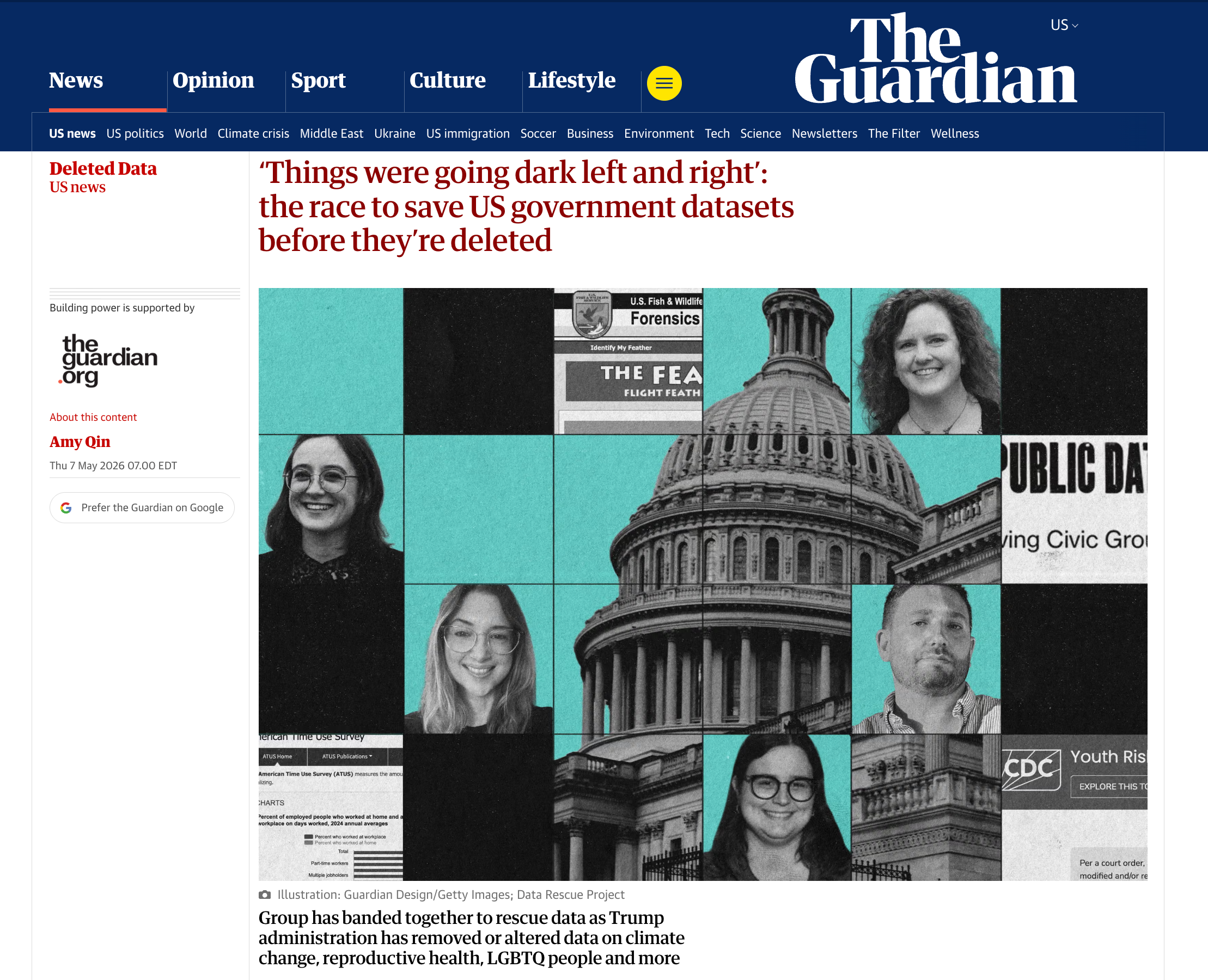
André is part of a group of “data rescuers” who’ve banded together during Trump’s second term. They’ve been quietly racing to save hundreds of critical government datasets before they’re no longer available. Now known as the Data Rescue Project, it’s a grassroots network of more than 800 people around the world who spend up to 40 hours a week painstakingly archiving the US government’s digital footprint in their spare time.
Anyone can join, but the majority of volunteers are librarians and academics, said Lynda Kellam, a university data librarian and a founding member of the Data Rescue Project. Programmers from the open-source software community and retirees also work on the project. Some, like André, contribute anonymously. What brings everyone together is the belief that “public data should be a public good”, said Kellam.
“We want people to recognize that this is a public good, just like roads and bridges and other kinds of infrastructure.”
[Clip]
“It’s very much a social movement,” she [Kellam] said, adding that there are now more than 20 groups and thousands of people advocating for public data in different ways, from the Internet Archive to the Environmental Data & Governance Initiative, which is documenting changes to federal environmental data and language with the help of webpages archived on the Internet Archive.
“We’re not going to have a million-person march on Washington on public data,” Kellam said. “But being able to get people interested in a topic that is somewhat nerdy and niche – I think we’ve been really successful with that.”
Learn More, Read the Complete Article (about 1100 words)
More From The Guardian
The Trump Administration is Deleting Government Data. From Infant Deaths to Hunger, Here Are 5 Ways It’s Hurting American
For decades, federal agencies have gathered data on everything from climate risk to the rising cost of childcare. It is information funded by taxes, and that belongs to the American people. This data is often how the government decides what to do: what is a problem, what is a policy priority, what should be funded. It tells the story of America.
But over the past year, the Trump administration has been altering and removing decades’ worth of datasets as part of a sweeping campaign targeting so-called “woke programs”, “racial equity”, “gender ideology” and “climate extremism”.
This censorship has affected not just datasets, but also a wide swath of federal resources: tools that helped the public access data, ongoing surveys and, perhaps most concerning, the agency staff that made it all possible.
Read the Complete Article, View Interactive Graphics
Filed under: Data Files, News

About Gary Price
Gary Price (gprice@gmail.com) is a librarian, writer, consultant, and frequent conference speaker based in the Washington D.C. metro area. He earned his MLIS degree from Wayne State University in Detroit. Price has won several awards including the SLA Innovations in Technology Award and Alumnus of the Year from the Wayne St. University Library and Information Science Program. From 2006-2009 he was Director of Online Information Services at Ask.com.
ADVERTISEMENT
Archives

ADVERTISEMENT