

SUBSCRIBE
SUBSCRIBE
EXPLORE +
  • About infoDOCKET
  • Academic Libraries on LJ
  • Research on LJ
  • News on LJ
  • Skip to primary navigation
  • Skip to main content
  • Skip to primary sidebar
  • Libraries
    • Academic Libraries
    • Government Libraries
    • National Libraries
    • Public Libraries
  • Companies (Publishers/Vendors)
    • EBSCO
    • Elsevier
    • Ex Libris
    • Frontiers
    • Gale
    • PLOS
    • Scholastic
  • New Resources
    • Dashboards
    • Data Files
    • Digital Collections
    • Digital Preservation
    • Interactive Tools
    • Maps
    • Other
    • Podcasts
    • Productivity
  • New Research
    • Conference Presentations
    • Journal Articles
    • Lecture
    • New Issue
    • Reports
  • Topics
    • Archives & Special Collections
    • Associations & Organizations
    • Awards
    • Funding
    • Interviews
    • Jobs
    • Management & Leadership
    • News
    • Patrons & Users
    • Preservation
    • Profiles
    • Publishing
    • Roundup
    • Scholarly Communications
      • Open Access

April 10, 2012 by Gary Price

New: Use Wolfram|Alpha to Analyze Shakespeare and Other Great Works of Literature

April 10, 2012 by Gary Price

Here’s yet another example for your growing list of things  you can do with Wolfram|Alpha, the superb and always expanding reference and ready reference tool.
From a Wolfram|Alpha Blog Post:

For hundreds of years, scholars have carefully studied the plays of Shakespeare, breaking down the language and carefully dissecting every act and scene. We thought it would be interesting to see what sorts of computational insights Wolfram|Alpha could provide, so we uploaded the complete catalog of Shakespeare’s plays into our database. This allows our users to examine Romeo and Juliet, Macbeth, Othello, and the rest of the Bard’s plays in an entirely new way.
Entering a play into Wolfram|Alpha, like A Midsummer Night’s Dream, brings up basic information, such as number of acts, scenes, and characters. It also provides more in-depth info like longest word, most frequent words, number of words and sentences, and more. It’s also easy to find more specific information about a particular act or scene with queries like “What is the longest word in King Lear?”, “What is the average sentence length of Macbeth?”, and “How many unique words are there in Twelfth Night?“

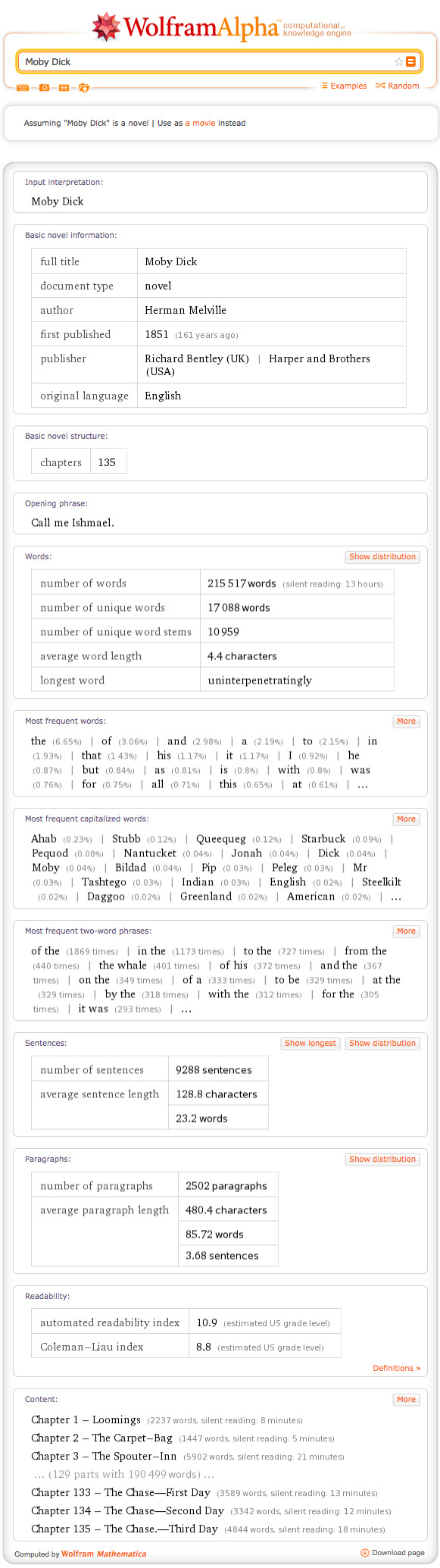
The post also mentions that you can also use Wolfram|Alpha for computional analysis of other great works of literature including Moby Dick, Great Expectations, and Adventures of Huckleberry Finn
Read the Complete Post for More Examples
A Couple of Screenshots
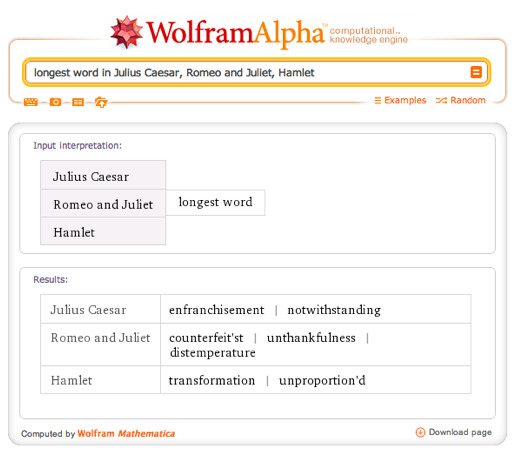
Search: Longest Word in Julius Caesar, Romeo and Juliet, Hamlet
Search: Moby Dick
Filed under: Patrons and Users, Resources

SHARE:

DatabasesFeaturedHumanitiesLiteratureOnline Research & ReferenceReference ResourcesWolfram|Alpha

About Gary Price

Gary Price (gprice@gmail.com) is a librarian, writer, consultant, and frequent conference speaker based in the Washington D.C. metro area. He earned his MLIS degree from Wayne State University in Detroit. Price has won several awards including the SLA Innovations in Technology Award and Alumnus of the Year from the Wayne St. University Library and Information Science Program. From 2006-2009 he was Director of Online Information Services at Ask.com.

ADVERTISEMENT

Archives

Job Zone

ADVERTISEMENT

Related Infodocket Posts

ADVERTISEMENT

FOLLOW US ON X

Tweets by infoDOCKET

ADVERTISEMENT

This coverage is free for all visitors. Your support makes this possible.

This coverage is free for all visitors. Your support makes this possible.

Primary Sidebar

  • News
  • Reviews+
  • Technology
  • Programs+
  • Design
  • Leadership
  • People
  • COVID-19
  • Advocacy
  • Opinion
  • INFOdocket
  • Job Zone

Reviews+

  • Booklists
  • Prepub Alert
  • Book Pulse
  • Media
  • Readers' Advisory
  • Self-Published Books
  • Review Submissions
  • Review for LJ

Awards

  • Library of the Year
  • Librarian of the Year
  • Movers & Shakers 2022
  • Paralibrarian of the Year
  • Best Small Library
  • Marketer of the Year
  • All Awards Guidelines
  • Community Impact Prize

Resources

  • LJ Index/Star Libraries
  • Research
  • White Papers / Case Studies

Events & PD

  • Online Courses
  • In-Person Events
  • Virtual Events
  • Webcasts
  • About Us
  • Contact Us
  • Advertise
  • Subscribe
  • Media Inquiries
  • Newsletter Sign Up
  • Submit Features/News
  • Data Privacy
  • Terms of Use
  • Terms of Sale
  • FAQs
  • Careers at MSI


© 2026 Library Journal. All rights reserved.


© 2022 Library Journal. All rights reserved.