

Most College Students Use AI, Even as Institutions Lag on Clear Policies (AI in Higher Education Widespread Use, Unclear Rules Report From Lumina Foundation-Gallup)
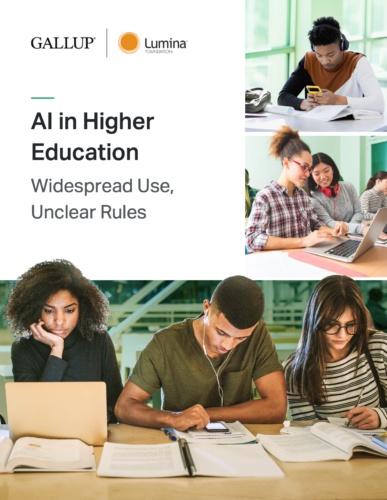
Artificial intelligence has become a routine part of college life, even as many institutions struggle to set clear rules for its use. New research from Lumina Foundation and Gallup finds that a majority of college students now use AI tools such as ChatGPT, Microsoft Copilot and Google Gemini for their coursework at least weekly, including many students at schools that discourage or prohibit their use.
The Lumina Foundation-Gallup State of Higher Education Study, based on a survey of nearly 4,000 associate and bachelor’s degree students, finds that 57% use AI daily or weekly for schoolwork, while just 13% say they never use it. Yet more than half of students (53%) say their institution discourages or prohibits AI use in coursework, and 52% report that at least some of their classes lack clear guidance on specific use policies.
The findings point to a gap between student behavior and institutional policy — one with implications for academic integrity, teaching practices and workforce preparation.
Students Turn to AI to Support Learning
Among students who use AI for their schoolwork at least monthly, 86% say a very or extremely important reason is to better understand complex course material. Large majorities also cite saving time (76%), improving grades (70%) and preparing for their future career (65%) as key motivations.
Among those who use AI at least infrequently, the most common uses include getting help with coursework they don’t understand and checking answers on assignments. At least six in 10 AI users report doing these activities daily or weekly.
Students who avoid using AI cite ethical concerns rather than a lack of access or knowledge. Nearly three-quarters (74%) say they view AI use as unethical or a form of cheating, and 68% cite institutional rules that discourage or prohibit it. Only 14% say they avoid AI because they do not know how to use the tools.
Policies Haven’t Kept Pace With Student Behavior
Despite widespread adoption, only 7% of students say their institution encourages AI use as much as possible. Forty-two percent say their school discourages AI in most circumstances, and 11% say it is outright prohibited.
Even where restrictions exist, students continue to use AI regularly: 48% of students at schools that discourage AI still use it weekly, as do 27% of students at schools that prohibit it.
Policy clarity also varies across classrooms. Just 51% of students at four-year institutions and 43% at two-year colleges say all of their courses have clear AI policies.
Workforce Concerns Heighten the Stakes
Students see AI not only as a classroom tool but also as a force reshaping the job market. Nearly half (47%) say they have given at least a fair amount of thought to changing their major because of AI’s impact on careers, and 16% report having already done so. Additionally, 12% say concerns about AI’s impact on the job market have influenced their decision to enroll in college.
While 58% of students say their school provides the right amount of AI training, nearly three in 10 say they are not receiving enough instruction. That figure rises to 34% at institutions that discourage AI use and 39% at institutions that prohibit it.
The findings suggest that institutions face a critical inflection point: whether to treat AI primarily as a compliance challenge or as a tool that, with appropriate guardrails, can support learning and workforce readiness.
Direct to Full Text Report
14 pages; PDF.
See Also: Gallup: College Students Weigh AI’s Impact on Majors and Careers
Filed under: Jobs, News, Patrons and Users

About Gary Price
Gary Price (gprice@gmail.com) is a librarian, writer, consultant, and frequent conference speaker based in the Washington D.C. metro area. He earned his MLIS degree from Wayne State University in Detroit. Price has won several awards including the SLA Innovations in Technology Award and Alumnus of the Year from the Wayne St. University Library and Information Science Program. From 2006-2009 he was Director of Online Information Services at Ask.com.
ADVERTISEMENT
Archives

ADVERTISEMENT