

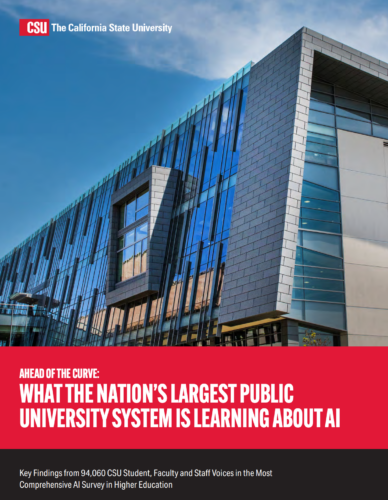
New Report From California State University (CSU): “Ahead of the Curve: What the Nation’s Largest Public University System is Learning about AI”
From a CSU Release:
The California State University (CSU) has released findings from its first-ever systemwide survey on artificial intelligence (AI), marking the largest and most comprehensive survey to date on generative artificial intelligence (AI) in higher education. The survey draws on more than 94,000 responses from faculty, staff, and students, offering key insights into higher education’s relationship with AI—one that is both promising and complex.
The new report, “Ahead of the Curve: What the Nation’s Largest Public University System is Learning about AI,” comes at a time when colleges and universities across the country are determining how to prepare students for an AI-shaped workforce while preserving academic integrity, critical thinking and public trust. The CSU AI survey’s findings suggest the question is no longer whether AI belongs in higher education, but how institutions should lead its use thoughtfully, consistently and at scale.
[Clip]
Developed by researchers at San Diego State University, the CSU AI Survey was conducted in fall 2025. The CSU’s more than 470,000 students and more than 61,000 faculty and staff were invited to participate in the survey, which asked questions in five core sections: awareness and understanding of AI; experience and usage of AI; perceptions and attitudes toward AI; skills education and training of AI; and future expectations of AI. Of the more than 94,000 respondents, just over 80,000 were students—85% undergraduates—more than 6,000 were faculty and more than 7,300 were staff.
Key Findings
The survey results reveal that AI awareness across the CSU’s 22 campuses is high and that most students, faculty and staff are engaging meaningfully with it. What is also clear from the results is that adoption of AI is not without concern. While engagement is high, respondents are taking a cautious approach to AI use, not entirely trusting AI’s accuracy and expressing the importance of verifying AI outputs. There is also a near universal demand for transparency, ethical use, and responsible regulation of AI.
The following are some of the survey’s key findings:
- AI use is widespread.
- More than half of students, six in 10 faculty and two thirds of staff regularly use AI-powered tools.
- Ninety-five percent of respondents used at least one of the 21 AI tools listed in the survey.
- Demand for training is real, and the students who need it most want it most.
- More than eight in 10 staff respondents and roughly seven in 10 faculty want formal AI training.
- About half of student respondents express the same interest—but first-generation students lead at 53% compared with 45% of non-first-generation students.
- Ethical lines are being drawn.
- About 80% of student respondents are not comfortable submitting AI-generated work as their own.
- The majority of faculty, staff and student respondents say it is necessary to verify the accuracy of AI-generated content.
- Faculty are addressing AI in the classroom and guiding students on how to use it.
- More than half of faculty respondents use AI to develop course materials, and 69% provide students with guidance on how to use AI effectively.
- Two-thirds include an explicit AI statement in their syllabi.
- There is widespread belief that AI is the future—paired with job security fears.
- About 82% of staff respondents, 78% of faculty and 69% of students believe AI will become an essential part of most professions.
- 82% of students, 78% of faculty and 74% of staff express concern about AI’s impact on job security.
Report Resources
- Direct to Full Text Report: Ahead of the Curve: What the Nation’s Largest Public University System is Learning about AI
32 pages; PDF. - Direct to Executive Summary
2 pages; PDF. - Direct to Data Dashboard
- Direct to Complete Media Release
Filed under: Dashboards, Data Files, News

About Gary Price
Gary Price (gprice@gmail.com) is a librarian, writer, consultant, and frequent conference speaker based in the Washington D.C. metro area. He earned his MLIS degree from Wayne State University in Detroit. Price has won several awards including the SLA Innovations in Technology Award and Alumnus of the Year from the Wayne St. University Library and Information Science Program. From 2006-2009 he was Director of Online Information Services at Ask.com.
ADVERTISEMENT
Archives
ADVERTISEMENT