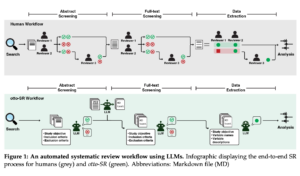
Scientists say they have used artificial intelligence (AI) to reproduce 12 systematic reviews in two days — slashing the time it takes to produce these ‘gold-standard’ studies, which bring together the results of multiple publications and normally take many months to do.
The new system, described in a preprint posted on medRxiv last week, could help to accelerate the production of influential reviews used by doctors and policymakers, its developers say. Using large language models (LLMs) to accelerate two laborious steps in the systematic-review process allowed the team to rapidly reproduce a dozen Cochrane reviews — a particularly rigorous type of study — and even to update a review in just 20 minutes, says co-author Christian Cao, a medical student at the University of Toronto, Canada.
Source: 10.1101/2025.06.13.25329541
[Clip]
The preprint caused a buzz in the systematic review community when it was posted last week. But [Justin] Clark’s [Bond University] excitement was dampened, he says, on scrutinizing the study and seeing that “it only does two of the big tasks of a review”. It does not design the review, search for studies, screen them for risk of bias, analyse the data or write up the results, which can all be difficult and time-consuming. Advances in technology will probably make it possible to automatically add studies to existing systematic reviews within a couple of years, he says, but it will take longer to develop a fully-automated system that can generate a review from scratch.
Gary Price (gprice@gmail.com) is a librarian, writer, consultant, and frequent conference speaker based in the Washington D.C. metro area.
He earned his MLIS degree from Wayne State University in Detroit.
Price has won several awards including the SLA Innovations in Technology Award and Alumnus of the Year from the Wayne St. University Library and Information Science Program. From 2006-2009 he was Director of Online Information Services at Ask.com.