SUBSCRIBE
SUBSCRIBE
EXPLORE +
  • About infoDOCKET
  • Academic Libraries on LJ
  • Research on LJ
  • News on LJ
  • Skip to primary navigation
  • Skip to main content
  • Skip to primary sidebar
  • Libraries
    • Academic Libraries
    • Government Libraries
    • National Libraries
    • Public Libraries
  • Companies (Publishers/Vendors)
    • EBSCO
    • Elsevier
    • Ex Libris
    • Frontiers
    • Gale
    • PLOS
    • Scholastic
  • New Resources
    • Dashboards
    • Data Files
    • Digital Collections
    • Digital Preservation
    • Interactive Tools
    • Maps
    • Other
    • Podcasts
    • Productivity
  • New Research
    • Conference Presentations
    • Journal Articles
    • Lecture
    • New Issue
    • Reports
  • Topics
    • Archives & Special Collections
    • Associations & Organizations
    • Awards
    • Funding
    • Interviews
    • Jobs
    • Management & Leadership
    • News
    • Patrons & Users
    • Preservation
    • Profiles
    • Publishing
    • Roundup
    • Scholarly Communications
      • Open Access

April 21, 2024 by Gary Price

Research Article (Preprint): “The Emerging AI Divide in the United States”

April 21, 2024 by Gary Price

The preprint linked below was recently share on arXiv.

Title

The Emerging AI Divide in the United States

Authors

Madeleine I. G. Daepp
Microsoft Research 

Scott Counts
Microsoft Research

Source

via arXiv
DOI: 10.48550/arXiv.2404.11988

Abstract

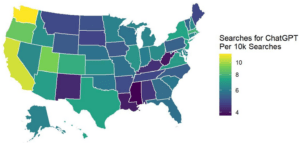
The digital divide describes disparities in access to and usage of digital tooling between social and economic groups. Emerging generative artificial intelligence tools, which strongly affect productivity, could magnify the impact of these divides. However, the affordability, multi-modality, and multilingual capabilities of these tools could also make them more accessible to diverse users in comparison with previous forms of digital tooling. In this study, we characterize spatial differences in U.S. residents’ knowledge of a new generative AI tool, ChatGPT, through an analysis of state- and county-level search query data. In the first six months after the tool’s release, we observe the highest rates of users searching for ChatGPT in West Coast states and persistently low rates of search in Appalachian and Gulf states. Counties with the highest rates of search are relatively more urbanized and have proportionally more educated, more economically advantaged, and more Asian residents in comparison with other counties or with the U.S. average. In multilevel models adjusting for socioeconomic and demographic factors as well as industry makeup, education is the strongest positive predictor of rates of search for generative AI tooling. Although generative AI technologies may be novel, early differences in uptake appear to be following familiar paths of digital marginalization.

Fig. 1 Rates of Search for ChatGPT by State. Colors indicate the fraction of all searches that included reference to ChatGPT in each state-period observation across the first six months since the initial public release of the generative artificial intelligence tool. Source: DOI: 10.48550/arXiv.2404.11988

Direct to Full Text
April 18, 2024
21 pages; PDF.

Filed under: Data Files, News, Patrons and Users, Productivity

SHARE:

About Gary Price

Gary Price (gprice@gmail.com) is a librarian, writer, consultant, and frequent conference speaker based in the Washington D.C. metro area. He earned his MLIS degree from Wayne State University in Detroit. Price has won several awards including the SLA Innovations in Technology Award and Alumnus of the Year from the Wayne St. University Library and Information Science Program. From 2006-2009 he was Director of Online Information Services at Ask.com.


ADVERTISEMENT

Archives

Job Zone

ADVERTISEMENT

Related Infodocket Posts

ADVERTISEMENT

FOLLOW US ON X

Tweets by infoDOCKET

ADVERTISEMENT

This coverage is free for all visitors. Your support makes this possible.

This coverage is free for all visitors. Your support makes this possible.

Primary Sidebar

  • News
  • Reviews+
  • Technology
  • Programs+
  • Design
  • Leadership
  • People
  • COVID-19
  • Advocacy
  • Opinion
  • INFOdocket
  • Job Zone

Reviews+

  • Booklists
  • Prepub Alert
  • Book Pulse
  • Media
  • Readers' Advisory
  • Self-Published Books
  • Review Submissions
  • Review for LJ

Awards

  • Library of the Year
  • Librarian of the Year
  • Movers & Shakers 2022
  • Paralibrarian of the Year
  • Best Small Library
  • Marketer of the Year
  • All Awards Guidelines
  • Community Impact Prize

Resources

  • LJ Index/Star Libraries
  • Research
  • White Papers / Case Studies

Events & PD

  • Online Courses
  • In-Person Events
  • Virtual Events
  • Webcasts
  • About Us
  • Contact Us
  • Advertise
  • Subscribe
  • Media Inquiries
  • Newsletter Sign Up
  • Submit Features/News
  • Data Privacy
  • Terms of Use
  • Terms of Sale
  • FAQs
  • Careers at MSI


© 2026 Library Journal. All rights reserved.


© 2022 Library Journal. All rights reserved.