

New Report/Data: “Enrollment and Employees in Postsecondary Institutions, Fall 2017; and Financial Statistics and Academic Libraries, Fiscal Year 2017”
From the National Center for Educations Statistics:
The percent of revenues that postsecondary institutions received from tuition and fees in 2016-17 varied greatly depending on the type of institution.
According to new data released today by the National Center for Education Statistics, public 4-year institutions and administrative offices received about 21 percent of their revenues from tuition and fees in Fiscal Year (FY) 2017, compared with just over 30 percent at private nonprofit entities and just over 92 percent at private for-profit entities.
The National Center for Education Statistics released a new First Look report today (November 6) that presents preliminary data findings from the Integrated Postsecondary Education Data System (IPEDS) spring 2018 collection. This collection included four survey components: Enrollment for fall 2017; Finance for fiscal year 2017; data on employees in postsecondary education for Fall 2017; and data for Academic Libraries for fiscal year 2017.
Other findings include:
- In fall 2017, of the approximately 20.1 million students enrolled at Title IV institutions, approximately 17.1 million were undergraduates and approximately 3.0 million were enrolled as graduate students. Of the 17.1 million undergraduate students, 63 percent were enrolled in 4-year institutions, 35 percent in 2‑year institutions, and 1 percent in less-than-2-year institutions.
- In fiscal year approximately 28 percent of expenses at public 4-year entities were for instruction, compared with approximately 42 percent at public 2-year entities and nearly 52 percent at public less-than-2-year entities.
- Title IV institutions and administrative offices reported employing approximately 4.0 million individuals in fall 2017. Of the 4.0 million individuals, approximately 2.6 million were employed full-time and 1.4 million were employed part-time.
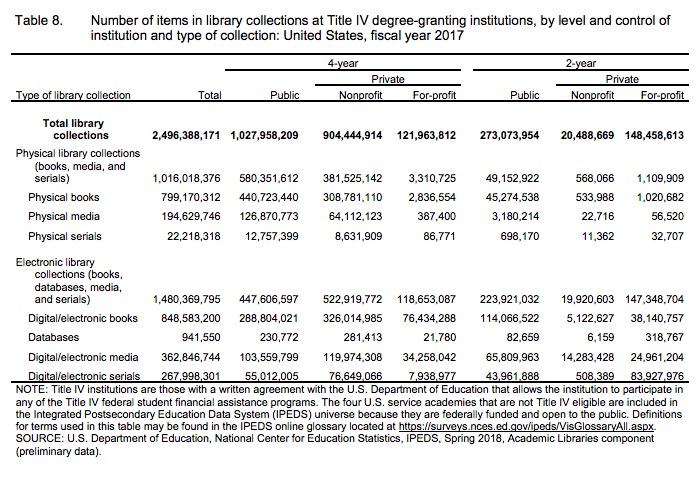
Academic Library Data Table
Eligible Title IV degree-granting institutions reported approximately 1.0 billion items in physical library collections (books, media, and serials) and approximately 1.5 billion items in electronic library collections (books, databases, media, and serials).
Direct to Full Text Report
34 pages; PDF.
See Also (New Today): Postsecondary Institutions and Cost of Attendance in 2017-18; Degrees and Other Awards Conferred: 2016-17; and 12-Month Enrollment: 2016-17: First Look (Provisional Data)
22 pages; PDF.
Between 2015-16 and 2017-18, the average tuition and required fees at 4-year public institutions increased more than 2 percent for both in-state and out-of-state students (after adjusting for inflation). During that same time period, tuition and required fees increased more than 3 percent at 4-year nonprofit institutions and decreased by 1.5 percent at for-profit institutions.
The National Center for Education Statistics released a new First Look report today
(November 6) that is a revised version of the preliminary report released on June 5, 2018. It includes fully edited and imputed data from the Integrated Postsecondary Education Data System (IPEDS) fall 2017 collection. This collection included three survey components: Institutional Characteristics for the 2017-18 academic year, Completions covering the period July 1, 2016, through June 30, 2017, and data on 12-Month Enrollment for the 2016-17 academic year.
Other findings include:
-
In 2017-18, there were 6,642 Title IV institutions in the United States and other U.S. jurisdictions—2,902 were classified as 4-year institutions, 1,932 were 2-year institutions, and the remaining 1,808 were less-than-2-year institutions;
-
Of the roughly 3.3 million students receiving degrees or certificates at 4-year Title IV degree-granting institutions, more than 58 percent received a bachelor’s degree. This percentage varied by control of institution, with about 64 percent of the 2.0 million students at public institutions receiving a bachelor’s degree, roughly 53 percent of the 1.1 million students at nonprofit institutions receiving a bachelor’s degree, and about 41 percent of the 277,000 students at for-profit institutions receiving a bachelor’s degree;
-
Institutions reported a 12-month unduplicated headcount enrollment of about 26.7 million individual students. Of these, roughly 22.9 million were undergraduates and approximately 3.8 million were graduate students.
Filed under: Academic Libraries, Awards, Data Files, Libraries, News

About Gary Price
Gary Price (gprice@gmail.com) is a librarian, writer, consultant, and frequent conference speaker based in the Washington D.C. metro area. He earned his MLIS degree from Wayne State University in Detroit. Price has won several awards including the SLA Innovations in Technology Award and Alumnus of the Year from the Wayne St. University Library and Information Science Program. From 2006-2009 he was Director of Online Information Services at Ask.com.
ADVERTISEMENT
Archives
ADVERTISEMENT