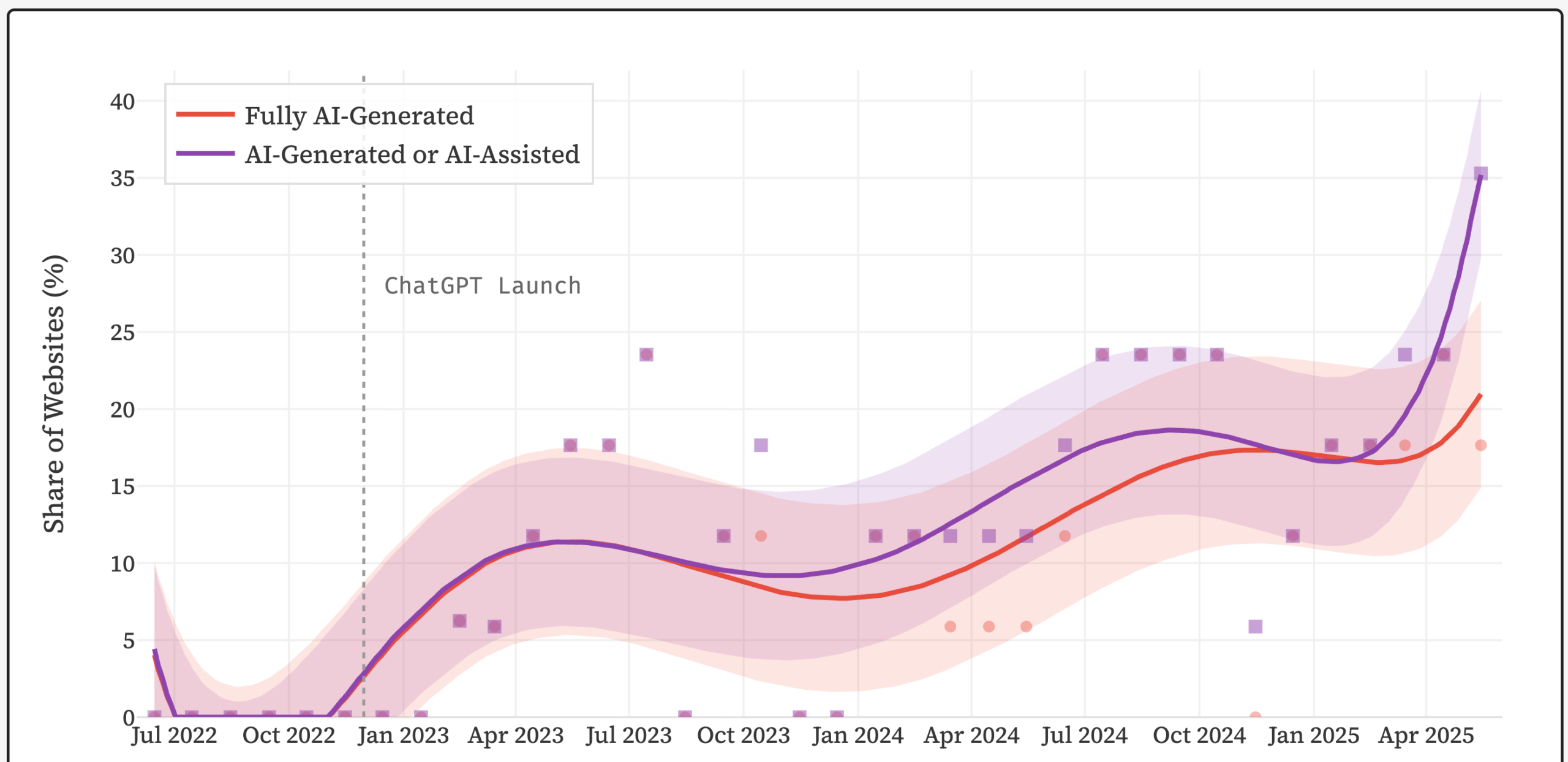
The proliferation of AI-generated and AI-assisted text on the internet is feared to contribute to a degradation in semantic and stylistic diversity, factual accuracy, and other negative developments. We find that by mid-2025, roughly 35% of newly published websites were classified as AI-generated or AI-assisted, up from zero before ChatGPT’s launch in late 2022. We also find evidence suggesting that increases in AI-generated text on the internet bring about a decrease in semantic diversity and an increase in positive sentiment. We do not, however, find statistically significant evidence supporting the hypothesis that an increased rate of AI-generated text on the internet decreases factual accuracy or stylistic diversity. Notably, our findings diverge from public perception of AI’s impact on the internet.
AI-Generated Text on the Internet from Mid-2022 to Mid-2025. The proportion of websites classified as fully AI-generated (red) and AI-generated or AI-assisted (purple) based on Pangram v3 detection applied to representative samples obtained from the Internet Archive. The dashed line marks ChatGPT’s public launch in November 2022.
Gary Price (gprice@gmail.com) is a librarian, writer, consultant, and frequent conference speaker based in the Washington D.C. metro area.
He earned his MLIS degree from Wayne State University in Detroit.
Price has won several awards including the SLA Innovations in Technology Award and Alumnus of the Year from the Wayne St. University Library and Information Science Program. From 2006-2009 he was Director of Online Information Services at Ask.com.