SUBSCRIBE
SUBSCRIBE
EXPLORE +
  • About infoDOCKET
  • Academic Libraries on LJ
  • Research on LJ
  • News on LJ
  • Skip to primary navigation
  • Skip to main content
  • Skip to primary sidebar
  • Libraries
    • Academic Libraries
    • Government Libraries
    • National Libraries
    • Public Libraries
  • Companies (Publishers/Vendors)
    • EBSCO
    • Elsevier
    • Ex Libris
    • Frontiers
    • Gale
    • PLOS
    • Scholastic
  • New Resources
    • Dashboards
    • Data Files
    • Digital Collections
    • Digital Preservation
    • Interactive Tools
    • Maps
    • Other
    • Podcasts
    • Productivity
  • New Research
    • Conference Presentations
    • Journal Articles
    • Lecture
    • New Issue
    • Reports
  • Topics
    • Archives & Special Collections
    • Associations & Organizations
    • Awards
    • Funding
    • Interviews
    • Jobs
    • Management & Leadership
    • News
    • Patrons & Users
    • Preservation
    • Profiles
    • Publishing
    • Roundup
    • Scholarly Communications
      • Open Access

March 26, 2026 by Gary Price

Research Paper (preprint): How are AI Agents Used? Evidence From 177,000 MCP Tools

March 26, 2026 by Gary Price

The preprint linked below was recently shared on arXiv.

Title

How are AI Agents Used? Evidence From 177,000 MCP Tools

Author

Merlin Stein
UK AI Security Institute, University of Oxford

Source

via arXiv
DOI: 10.48550/arXiv.2603.23802

Abstract

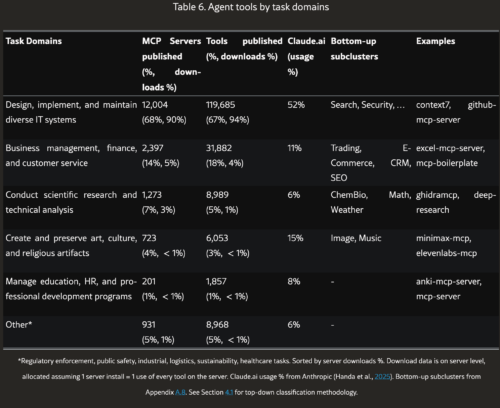
Today’s AI agents are built on large language models (LLMs) equipped with tools to access and modify external environments, such as corporate file systems, API-accessible platforms and websites. AI agents offer the promise of automating computer-based tasks across the economy. However, developers, researchers and governments lack an understanding of how AI agents are currently being used, and for what kinds of (consequential) tasks. To address this gap, we evaluated 177,436 agent tools created from 11/2024 to 02/2026 by monitoring public Model Context Protocol (MCP) server repositories, the current predominant standard for agent tools. We categorise tools according to their direct impact: perception tools to access and read data, reasoning tools to analyse data or concepts, and action tools to directly modify external environments, like file editing, sending emails or steering drones in the physical world.

Source: 10.48550/arXiv.2603.23802

We use O*NET mapping to identify each tool’s task domain and consequentiality. Software development accounts for 67% of all agent tools, and 90% of MCP server downloads. Notably, the share of ‘action’ tools rose from 27% to 65% of total usage over the 16-month period sampled. While most action tools support medium-stakes tasks like editing files, there are action tools for higher-stakes tasks like financial transactions. Using agentic financial transactions as an example, we demonstrate how governments and regulators can use this monitoring method to extend oversight beyond model outputs to the tool layer to monitor risks of agent deployment.

Direct to Abstract, Link to Full Text 

Filed under: Data Files, Journal Articles, News, Open Access

SHARE:

About Gary Price

Gary Price (gprice@gmail.com) is a librarian, writer, consultant, and frequent conference speaker based in the Washington D.C. metro area. He earned his MLIS degree from Wayne State University in Detroit. Price has won several awards including the SLA Innovations in Technology Award and Alumnus of the Year from the Wayne St. University Library and Information Science Program. From 2006-2009 he was Director of Online Information Services at Ask.com.


ADVERTISEMENT

Archives

Job Zone

ADVERTISEMENT

Related Infodocket Posts

ADVERTISEMENT

FOLLOW US ON X

Tweets by infoDOCKET

ADVERTISEMENT

This coverage is free for all visitors. Your support makes this possible.

This coverage is free for all visitors. Your support makes this possible.

Primary Sidebar

  • News
  • Reviews+
  • Technology
  • Programs+
  • Design
  • Leadership
  • People
  • COVID-19
  • Advocacy
  • Opinion
  • INFOdocket
  • Job Zone

Reviews+

  • Booklists
  • Prepub Alert
  • Book Pulse
  • Media
  • Readers' Advisory
  • Self-Published Books
  • Review Submissions
  • Review for LJ

Awards

  • Library of the Year
  • Librarian of the Year
  • Movers & Shakers 2022
  • Paralibrarian of the Year
  • Best Small Library
  • Marketer of the Year
  • All Awards Guidelines
  • Community Impact Prize

Resources

  • LJ Index/Star Libraries
  • Research
  • White Papers / Case Studies

Events & PD

  • Online Courses
  • In-Person Events
  • Virtual Events
  • Webcasts
  • About Us
  • Contact Us
  • Advertise
  • Subscribe
  • Media Inquiries
  • Newsletter Sign Up
  • Submit Features/News
  • Data Privacy
  • Terms of Use
  • Terms of Sale
  • FAQs
  • Careers at MSI


© 2026 Library Journal. All rights reserved.


© 2022 Library Journal. All rights reserved.