
Ithaka S+R Publishes Library Partnership Development Framework
From an Ithaka S+R Blog Post by Melissa Blakenstein:
Public and academic libraries often serve the same populations through different institutional structures. In both settings, libraries regularly serve students balancing coursework, jobs, and family responsibilities, as well as community members seeking reliable internet access, workforce resources, or a place to study and connect. These shared audiences and missions create natural opportunities for collaboration across institutions, yet there is limited guidance on how they can work together intentionally and effectively to support their community’s basic needs.
Today we are pleased to announce the publication of the Library Partnership Development Framework, designed to help libraries and other collaborative institutions build, strengthen, and sustain collaborations that support student success and community wellbeing.
The framework is the culmination of research conducted through the Maximizing Public-Academic Library Partnerships (PALP) project. Drawing on case studies, a national inventory of library websites, and an in-person, participatory design institute with librarians, project advisors, and community stakeholders, the project explored how collaborations between public and academic libraries develop and evolve, as well as the challenges and opportunities they encounter along the way.
[Clip]
Building effective partnerships
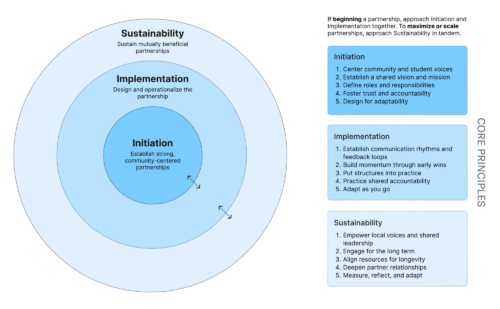
The framework organizes partnership development into three interconnected phases: initiation, implementation, and sustainability. Each phase includes guiding core principles, key stakeholders, and practical questions that partners can use to align their goals, clarify responsibilities, and evaluate progress. Institutions can enter the framework at any point depending on where they are in their partnership, whether they are beginning conversations with potential partners or looking to expand and deepen long-standing relationships.
Importantly, the framework is designed to be iterative rather than linear. Partnerships evolve over time, and the framework encourages organizations and libraries to revisit earlier stages, refine their approach, and adapt to changing community needs. This flexibility makes the framework relevant not only for new collaborations, but also for strengthening and expanding existing partnerships.
Across our research, one theme emerged clearly: libraries are increasingly acting as connectors within broader ecosystems of education, basic needs services, and community support. This insight applies more broadly as well. When organizations collaborate across institutional boundaries, they can extend their reach, access new resources, and respond more effectively to the full range of needs their communities face. By collaborating with each other and with partners across sectors, libraries and other institutions can extend their reach, increase funding opportunities, and better address the interconnected needs that shape community success and wellbeing.

Direct to Library Partnership Development Framework
Direct to Complete Blog Post
Filed under: Academic Libraries, Associations and Organizations, Funding, Jobs, Libraries, News

About Gary Price
Gary Price (gprice@gmail.com) is a librarian, writer, consultant, and frequent conference speaker based in the Washington D.C. metro area. He earned his MLIS degree from Wayne State University in Detroit. Price has won several awards including the SLA Innovations in Technology Award and Alumnus of the Year from the Wayne St. University Library and Information Science Program. From 2006-2009 he was Director of Online Information Services at Ask.com.
ADVERTISEMENT
Archives
ADVERTISEMENT