

New Report From IFLA: “Weak Signals: Emergent and Potential Trends Shaping the Future of Libraries”
From an International Federation of Library Associations and Institutions (IFLA) Releases Blog Post:
IFLA’s new Weak Signals Report brings together insights into developments across our field that have the potential to become trends in future. Created by recipients of our Emerging Leaders’ Grants at WLIC2025, it draws on ideas and experiences shared at our annual congress last year in Astana, Kazakhstan.
IFLA’s 2024 Trend Report is a tool available to the library field to support both internal planning and strategy development, and exchanges with other actors in the information space.
At its heart are a set of well-established and documented trends – major developments which are already underway, shaping the future of libraries and the wider knowledge and information environment.
Yet before something becomes a Trend, it is a signal. Weak signals in particular refer to emergent practices or tendencies which have the potential to become significant trends, although for the time being are only taking place at a limited scale, or to a limited extent.
[Clip]
Our new Weak Signals report therefore complements our existing Trend Report, providing a set of 24 signals that you can use, for anything from formal planning to simple reflection about the different ways in which libraries and the context in which they work might evolve.
[Clip]
Report Overview
The report looks at three broad categories of signals.
The first section focuses on developments coming from outside of the field, but which nonetheless could oblige libraries to adapt or update practices in order to respond effectively. These signals include broader evolutions in scholarly communication, and the drive towards openness, but also the politicisation of language policies and market developments around AI.
The second section turns to what we can see from looking into how libraries themselves are changing their practices in the light of technology. There are different perspectives around AI, from calls for caution in using it with young audiences, the growing role of libraries in supporting AI literacy and promoting human-centred technology, and the need for diligence in choosing which tools to use. Others look at how AI can enable more people to get involved in creating materials, how it can level the playing field when it comes to access to training, and more broadly how automation can enable libraries to more.
The third and final section looks beyond technology and at developments in how libraries and library services are being managed more broadly. There are signals focusing on changing perceptions around what leadership is and who can be a leader, as well as what happens when libraries are not staffed.
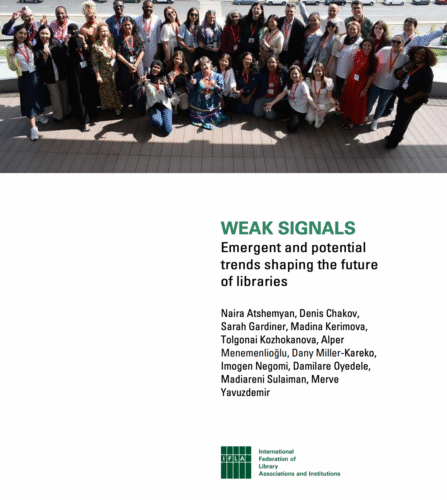
Direct to Complete Blog Post
Direct to Full Text Report: Weak Signals: Emergent and Potential Trends Shaping the Future of Libraries
Source: https://repository.ifla.org/handle/20.500.14598/7045
Filed under: Associations and Organizations, Funding, Libraries, Management and Leadership, News, Open Access

About Gary Price
Gary Price (gprice@gmail.com) is a librarian, writer, consultant, and frequent conference speaker based in the Washington D.C. metro area. He earned his MLIS degree from Wayne State University in Detroit. Price has won several awards including the SLA Innovations in Technology Award and Alumnus of the Year from the Wayne St. University Library and Information Science Program. From 2006-2009 he was Director of Online Information Services at Ask.com.
ADVERTISEMENT
Archives
ADVERTISEMENT