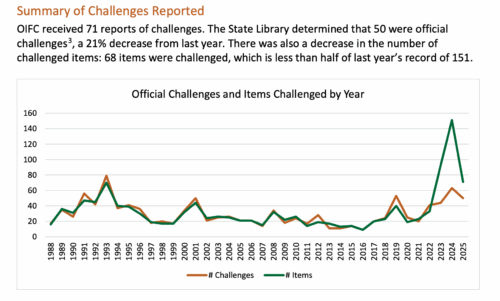
The 2025 OIFC Annual Report lists 50 official challenge incidents in public libraries, special libraries, and schools. The number of challenges is tied with 2001 as the fifth highest reported since the State Library began keeping track. The incidents included challenges to 66 unique titles and 68 items, the fourth highest number since 1987.
Source: OIFC 2025 Report, State Library of Oregon
Oregon’s high numbers match national trends. The American Library Association (ALA) reported that 2024 had the third highest attempts to censor library materials since they began collecting statistics in 1990. OIFC data is reported to ALA and compiled in their national statistics.
In a new trend for Oregon, 60% of challenged items were hidden or vandalized, rather than going through official channels. That amount compares to 40% last year. Common reasons people shared for challenging the remaining items were that they felt the materials contained:
Inappropriate sex or nudity.
Content about people who are two-spirit, lesbian, gay, bisexual, transgender, queer, intersex, asexual, or other identities related to sexual orientation or gender identity (2SLGBTQIA+).
Unsuitability to the material’s target age group.
While most challenges were to materials, 14% of official challenges were focused on library programs, displays, or entire content areas. These incidents included antisemitic graffiti, a challenge to all 2SLGBTQIA+ books, objection to a book club selection, and a request to remove books exhibiting transphobia from an office display.
The pattern is clear: most challenges target stories about people in underrepresented protected classes. In 2024–25, 76% of challenged items told the stories of or featured 2SLGBTQIA+ people, Black, Indigenous, or other people of color. Two challenge incidents involved staff who chose not to select materials with 2SLGBTQIA+ content.
The disproportionate impact of challenges on protected classes led to the Oregon State Legislature to pass Senate Bill 1098 in the 2025 session. The bill prohibits discrimination against protected classes when selecting or retaining school instructional, curricular, or library materials. Oregon joined Colorado, Connecticut, New York, and Rhode Island in passing “Freedom to Read”/anti-book ban bills in 2025.
“During these hard times, when libraries are facing threats to funding and library staff are facing threats to their livelihood, we will continue to support libraries, and their staff, to protect the freedom to read,” says Wendy Cornelisen, State Librarian.
Gary Price (gprice@gmail.com) is a librarian, writer, consultant, and frequent conference speaker based in the Washington D.C. metro area.
He earned his MLIS degree from Wayne State University in Detroit.
Price has won several awards including the SLA Innovations in Technology Award and Alumnus of the Year from the Wayne St. University Library and Information Science Program. From 2006-2009 he was Director of Online Information Services at Ask.com.