Weizhi Zhang (University of Illinois Chicago), et al. (22 additonal authors)
Source
via arXiv
DOI: 10.48550/arXiv.2506.18959
Abstract
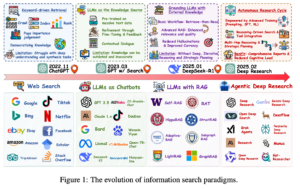
Information retrieval is a cornerstone of modern knowledge acquisition, enabling billions of queries each day across diverse domains. However, traditional keywordbased search engines are increasingly inadequate for handling complex, multi-step information needs. Our position is that Large Language Models (LLMs), endowed with reasoning and agentic capabilities, are ushering in a new paradigm termed Agentic Deep Research. These systems transcend conventional information search techniques by tightly integrating autonomous reasoning, iterative retrieval, and information synthesis into a dynamic feedback loop. We trace the evolution from static web search to interactive, agent-based systems that plan, explore, and learn. We also introduce a test-time scaling law to formalize the impact of computational depth on reasoning and search. Supported by benchmark results and the rise of open-source implementations, we demonstrate that Agentic Deep Research not only significantly outperforms existing approaches, but is also poised to become the dominant paradigm for future information seeking. All the related resources, including industry products, research papers, benchmark datasets, and open-source implementations, are collected for the community in https://github.com/ DavidZWZ/Awesome-Deep-Research.
Figure 1: The evolution of information search paradigms. Source: 10.48550/arXiv.2506.18959
Gary Price (gprice@gmail.com) is a librarian, writer, consultant, and frequent conference speaker based in the Washington D.C. metro area.
He earned his MLIS degree from Wayne State University in Detroit.
Price has won several awards including the SLA Innovations in Technology Award and Alumnus of the Year from the Wayne St. University Library and Information Science Program. From 2006-2009 he was Director of Online Information Services at Ask.com.