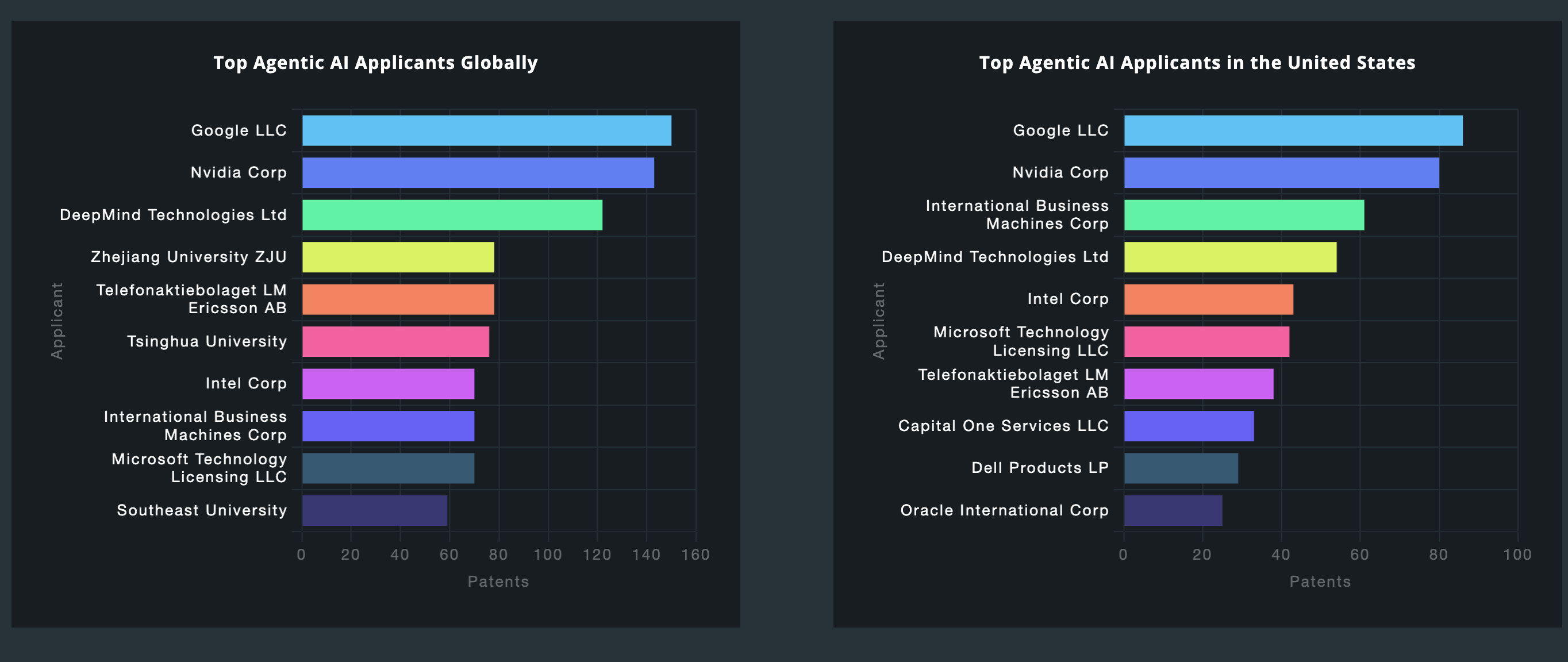
Here at IFI CLAIMS, we’re always looking for signals in patents to leading edge technologies. Agentic AI is still nascent and has a long way to go, but with any revolutionary technology, it’s always worth knowing who the first movers are when it comes to protecting inventions. We did that last year with an analysis on GenAI. Because the AI landscape is shifting rapidly—and that’s not even factoring in the market shocks of tariff volleys—we decided to take another look to see what has changed in the year or so since we last looked at the field. Here’s our breakdown of the competitive landscape— along with some additional analysis on OpenAI and DeepSeek, which surprised the markets in January while we were researching this topic. DeepSeek also showed the world how the AI competitive picture can change in an instant.
Source: IFI CLAIMS
Any way you look at AI patents over the time frame, Google leads. Globally, the search giant notched 1,837 AI patents, ahead of Samsung and Huawei. Google holds some 50% more than Microsoft and nearly double IBM on the world stage. Here is an example for one of Google’s AI patents for training neural networks to perform machine learning tasks.
Source: IFI CLAIMS
When it comes to generative AI patents, Google may be the frontrunner, but Microsoft, IBM, and Nvidia hold strong positions as well. This patent from IBM protects speech to text touchscreen graphics rendering. And this patent pending from Nvidia covers human demonstrations of a task when training machine learning models.
Gary Price (gprice@gmail.com) is a librarian, writer, consultant, and frequent conference speaker based in the Washington D.C. metro area.
He earned his MLIS degree from Wayne State University in Detroit.
Price has won several awards including the SLA Innovations in Technology Award and Alumnus of the Year from the Wayne St. University Library and Information Science Program. From 2006-2009 he was Director of Online Information Services at Ask.com.