Artificial intelligence is not new to the workplace, but the debut of ChatGPT just over two years ago ushered in an era of rapid expansion. American workers have mixed feelings about how this technology will affect jobs in the future.
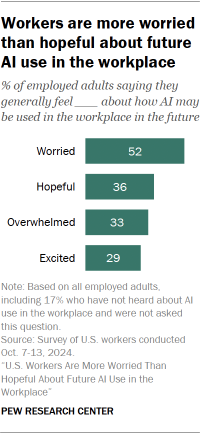
About half of workers (52%) say they’re worried about the future impact of AI use in the workplace, and 32% think it will lead to fewer job opportunities for them in the long run, according to a new Pew Research Center survey.
And while 36% of workers also say they feel hopeful about how AI may be used in the workplace in the future, a similar share (33%) say they feel overwhelmed.
About one-in-six workers (16%) say at least some of their work is currently done with AI. And an additional 25% say, while they’re not using it much now, at least some of their work can be done with AI. These shares are significantly higher among young workers and workers with at least a bachelor’s degree.
The survey, conducted Oct. 7-13 among 5,273 employed U.S. adults, explores how workers see the use of AI in the workplace overall, as well as their own experience with AI in their jobs.
Key Findings
Few workers think AI use in the workplace will improve their job prospects in the long run.
Most American workers (63%) say they don’t use AI much or at all in their job.
About one-in-ten workers say they use AI chatbots – such as ChatGPT, Gemini or Copilot – at work every day or a few times a week; 7% use them a few times a month.
Workers who have used AI chatbots are more likely to find them helpful in speeding up their work than in improving its quality.
Gary Price (gprice@gmail.com) is a librarian, writer, consultant, and frequent conference speaker based in the Washington D.C. metro area.
He earned his MLIS degree from Wayne State University in Detroit.
Price has won several awards including the SLA Innovations in Technology Award and Alumnus of the Year from the Wayne St. University Library and Information Science Program. From 2006-2009 he was Director of Online Information Services at Ask.com.