New analysis suggests that open data practice is now on the edge of becoming a standard, recognised and supported scholarly output, globally.
As part of the latest in the State of Open Data series, produced by partners Digital Science, Figshare and Springer Nature, direct author-sharing practices have been analysed from a funder, country and institutional level. The resulting data shows key trends driving successful open sharing and the growth of global adoption, while also enabling recommendations to be drawn to help bridge the remaining gaps between policy and practice.
More universities now have data sharing policies as part of their efforts to promote open science and research transparency.
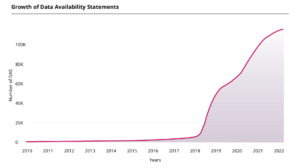
There has been a strong growth in papers linking to data from universities globally since 2010. Although there are differences regionally, with a spread of just 5-10% in data sharing policies, this is less significant than the number of articles (>85% ) that were previously not linked to data.
The success of open data initiatives reflects a broader policy environment. However, having policies in place is not sufficient on its own.
Policies for open data sharing are now more consistent globally, which has contributed to a general decline in “on request” sharing with reductions ranging from 1-9% in all but one country – i.e. researchers are now sharing more ‘naturally’. However, there are fluctuations in practice based on the type of research being funded and geolocation, and even where policies are in place, there is not necessarily a significant rise in repository sharing.
Source: The State of Open Data 2024
Global uptake of open research practice has increased, but is impacted by country-level motivations for data sharing.
The United States has the lowest percentage of researchers that are motivated through citation of their data (4.88%) while having the highest percentage being motivated by funder requirement (10.23%). Conversely, Ethiopia and Japan show similarity with a higher importance of motivation through citation of their data (9.3% and 14.8% respectively) and a similar low importance of motivation from funder requirement (at 2.33% and 1.67% respectively).
Resource disparities remain.
Progress in some countries is hindered by limitations in internet connectivity, institutional support, and a lack of awareness. Across the 10 regions analysed*, the US, UK, Germany, and France demonstrated similar trends in repository sharing, averaging around a 25% sharing rate. However, for Brazil, Ethiopia and India the sharing rate remains significantly below a quarter.
Sustained efforts are needed to respond to the challenges in diverse research areas.
A wide range of disciplines are now being covered by the growing number of data availability statement (DAS) policies, but many still lack established community practices, suitable repositories, and/or the ability to handle sensitive data which is difficult to share.
[Clip]
This year’s focused report combines three different data sources: Dimensions, Springer Nature Data Availability Statements and the Chan Zuckerberg Initiative-funded Data Citation Corpus, to look at the linkages between peer-reviewed published research and data sets being made available. The combination of these sources has enabled patterns to be analysed around how researchers are making their data open, to what standard, and better understand the real motivations for data sharing, to help inform how we as a community can effect positive change.
Gary Price (gprice@gmail.com) is a librarian, writer, consultant, and frequent conference speaker based in the Washington D.C. metro area.
He earned his MLIS degree from Wayne State University in Detroit.
Price has won several awards including the SLA Innovations in Technology Award and Alumnus of the Year from the Wayne St. University Library and Information Science Program. From 2006-2009 he was Director of Online Information Services at Ask.com.


New analysis suggests that open data practice is now on the edge of becoming a standard, recognised and supported scholarly output, globally.