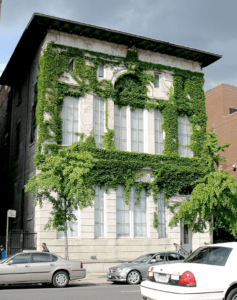
The Former 135th Street Branch of the New York Public Library (Image via Wikimedia Commons)
It was a banner day in the history of American libraries — and in Black history. On May 25, 1926, the New York Public Library announced that it had acquired the celebrated Afro-Latino bibliophile Arturo Schomburg’s collection of more than 4,000 books, manuscripts and other artifacts.
A year earlier, the library had established the first public collection dedicated to Black materials, at its 135th Street branch in Harlem. Now, the branch would be home to a trove of rare items, from some of the earliest books by and about Black people to then-new works of the brewing Harlem Renaissance.
Schomburg was the most famous of the Black bibliophiles who, starting in the late 19th century, had amassed impressive “parlor libraries” in their homes. Such libraries became important gathering places for Black writers and thinkers at a time when newly created public libraries — which exploded in number in the decades after 1870 — were uninterested in Black materials, and often unwelcoming to Black patrons.
Today, figures like Schomburg and the historian and activist W.E.B. Du Bois (another collector and compiler of Black books) are hailed as the founders of the 20th-century Black intellectual tradition. But increasingly, scholars are also uncovering the important role of the women who often ran the libraries, where they built collections and — just as important — communities of readers.
[Clip]
Researchers using the Schomburg Collection, when it was the 135th Street Branch Library Division of Negro Literature, History and Prints, in 1938. Photographs & Prints Division, Schomburg Center for Research in Black Culture, NYPL.
“Mr. Schomburg’s collection is really the seed,” said Joy Bivins, the current director of the Schomburg Center for Research in Black Culture, as the 135th Street library, currently home to more than 11 million items, is now known. “But in many ways, it is these women who were the institution builders.”
Many were among the first Black women to attend library school, where they learned the tools and the systems of the rapidly professionalizing field. On the job, they learned these tools weren’t always suited to Black books and ideas, so they invented their own.
At times, they battled overt and covert censorship that would be familiar in today’s climate of rising book bans and restrictions on teaching so-called divisive concepts. But whether they worked in world-famous research collections or modest public branch libraries, these pioneers saw their role as not just about tending old books but also about making room for new people and new ideas.
“These librarians were very tuned in and understood that a cultural movement also needs a space,” said Laura E. Helton, a historian at the University of Delaware and author of the recent book “Scattered and Fugitive Things: How Black Collectors Created Archives and Remade History.” “And libraries served that function in every town and city where they were set up.”
Gary Price (gprice@gmail.com) is a librarian, writer, consultant, and frequent conference speaker based in the Washington D.C. metro area.
He earned his MLIS degree from Wayne State University in Detroit.
Price has won several awards including the SLA Innovations in Technology Award and Alumnus of the Year from the Wayne St. University Library and Information Science Program. From 2006-2009 he was Director of Online Information Services at Ask.com.