The number of public school book bans across the country increased by 33 percent in the 2022-23 school year compared to the 2021-22 school year, according to a new PENAmerica report. “Banned in the USA: The Mounting Pressure to Censor” highlights the disproportionate number of bans occurring in Florida — where over 40 percent of all book bans took place in the 2022-23 school year — and shows how state legislation and coordinated pressure campaigns from local groups and individuals have driven mass restrictions on access to literature.
Since PENAmerica started tracking public school book bans in July 2021, the organization has recorded nearly 6,000 instances of banned books. This includes 3,362 book bans affecting 1,557 unique titles during the 2022-23 school year, impacting the work of 1,480 authors, illustrators, and translators.
Source: PEN America
There are multiple drivers of these trends. Over the past school year, vaguely-worded state legislation and local and national advocacy groups have converged, pressuring districts to remove more books from student access. Fear of penalties, legal liabilities, and criminal punishments are escalating book bans to new heights.
“The toll of the book banning movement is getting worse. More kids are losing access to books, more libraries are taking authors off the shelves, and opponents of free expression are pushing harder than ever to exert their power over students as a whole,” said Suzanne Nossel, Chief Executive Officer of PENAmerica. “Those who are bent on the suppression of stories and ideas are turning our schools into battlegrounds, compounding post-pandemic learning loss, driving teachers out of the classroom and denying the joy of reading to our kids. By depriving a rising generation of the freedom to read, these bans are eating away at the foundations of our democracy.”
This year Florida surpassed Texas as having the most books pulled from shelves. Laws and tactics that emerged in the Sunshine State are also being replicated elsewhere. The language of the so-called ‘Don’t Say Gay’ law that originated in Florida has been mimicked in Iowa, where vagueness and lack of state guidance similarly led school districts to ban books. Book Looks, a website created by a Moms for Liberty member from Florida to encourage book censorship, has been used widely to ban books, from Pennsylvania to Virginia.
The range of efforts to restrict teaching or intimidate educators also continues to expand. The escalation of book bans — combined with the proliferation of legislative efforts to restrict teaching about topics like race, gender, American history, and LGBTQ+ identities, as well as the rise in ‘educational intimidation’ mandates that require intrusive monitoring of teachers and librarians — pose a grave threat to the freedom to read and learn in schools across the country.
PEN America argues these efforts are part of an ongoing nationwide “Ed Scare” — a campaign to foment anxiety and anger with the ultimate goal of suppressing free expression in public education.
Among the report’s other major findings include:
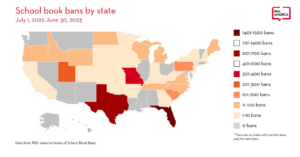
PENAmerica recorded 1,406 book ban cases in Florida, followed by 625 bans in Texas, 333 bans in Missouri, 281 bans in Utah, and 186 book bans in Pennsylvania. These cases are instances where books were banned from classrooms or libraries, or both, or were banned pending investigation, as per PENAmerica’s definitions.
Over 75 percent of the books banned are young adult books, middle grade books, chapter books, or picture books — in other words, books specifically written and selected for younger audiences.
Of the 3,362 books banned this year, 1,263 were banned from classrooms and school libraries, compared to only 333 books in this category last year. This represents an increase of nearly 400 percent compared to last school year.
Nearly half of all book bans (48 percent) during the 2022-23 school year deal with violence or physical abuse, including books that include sexual assault; 30 percent include characters of color and themes of race and racism; 30 percent represent LGBTQ+ identities; and six percent include a transgender character.
In the 153 school districts across the country that banned a book during the 2022-23 school year, 122 (80 percent) have a chapter or local affiliate nearby of one or more of the three most prominent national groups pushing for book bans — Moms for Liberty, Citizens Defending Freedom, and Parents’ Rights in Education. These districts are where 86 percent (2,902) of book bans have occurred.
Source: PEN America
According to Kasey Meehan, PENAmerica’s Freedom to Read program director and lead author of the report, “Hyperbolic and misleading rhetoric continues to ignite fear over the types of books in schools. And yet, 75 percent of all banned books are specifically written and selected for young audiences. Florida isn’t an anomaly – it’s providing a playbook for other states to follow suit. Students have been using their voices for months in resisting coordinated efforts to suppress teaching and learning about certain stories, identities, and histories; it’s time we follow their lead.”
One positive trend highlighted in the report is the continued growth in student pushback against book bans across the country. Youth resistance to book bans in numerous school districts has included protests, speaking out at school board meetings, and the establishment of national organizations dedicated to defending access to literature in schools.
This report expands on PENAmerica’s work documenting the spread of educational censorship in America’s schools, showing the rapid evolution and intensification of book-banning across the country since the April 2022 Banned in the USA report, which documented 1,477 instances of book bans in the first half of the 2021-22 school year.
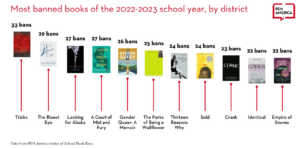
Author John Green, whose book, Looking for Alaska, was the third most banned in U.S. schools according to the report, said “While I’m encouraged by PENAmerica‘s work to protect free expression and intellectual freedom, it’s disappointing to see such a steep rise in the banning and restriction of books. We should trust our teachers and librarians to do their jobs. If you have a worldview that can be undone by a book, I would submit that the problem is not with the book.”
PENAmerica defines a school book ban as any action taken against a book based on its content and as a result of parent or community challenges, administrative decisions, or in response to direct or threatened action by lawmakers or other governmental officials, that leads to a previously accessible book being either completely removed from availability to students, or where access to a book is restricted or diminished.
Gary Price (gprice@gmail.com) is a librarian, writer, consultant, and frequent conference speaker based in the Washington D.C. metro area.
He earned his MLIS degree from Wayne State University in Detroit.
Price has won several awards including the SLA Innovations in Technology Award and Alumnus of the Year from the Wayne St. University Library and Information Science Program. From 2006-2009 he was Director of Online Information Services at Ask.com.