SUBSCRIBE
SUBSCRIBE
EXPLORE +
  • About infoDOCKET
  • Academic Libraries on LJ
  • Research on LJ
  • News on LJ
  • Skip to primary navigation
  • Skip to main content
  • Skip to primary sidebar
  • Libraries
    • Academic Libraries
    • Government Libraries
    • National Libraries
    • Public Libraries
  • Companies (Publishers/Vendors)
    • EBSCO
    • Elsevier
    • Ex Libris
    • Frontiers
    • Gale
    • PLOS
    • Scholastic
  • New Resources
    • Dashboards
    • Data Files
    • Digital Collections
    • Digital Preservation
    • Interactive Tools
    • Maps
    • Other
    • Podcasts
    • Productivity
  • New Research
    • Conference Presentations
    • Journal Articles
    • Lecture
    • New Issue
    • Reports
  • Topics
    • Archives & Special Collections
    • Associations & Organizations
    • Awards
    • Funding
    • Interviews
    • Jobs
    • Management & Leadership
    • News
    • Patrons & Users
    • Preservation
    • Profiles
    • Publishing
    • Roundup
    • Scholarly Communications
      • Open Access

December 13, 2022 by Gary Price

Public Library of Science (PLOS) Releases First Open Science Indicators Dataset

December 13, 2022 by Gary Price

DoFrom the PLOS Blog:

Open Science is on the rise. We can infer as much from the proliferation of Open Access publishing options; the steady upward trend in bioRxiv postings; the periodic rollout of new national, institutional, or funder policies.

But what do we actually know about the day-to-day realities of Open Science practice? What are the norms? How do they vary across different research subject areas and regions? Are Open Science practices shifting over time? Where might the next opportunity lie and where do barriers to adoption persist?

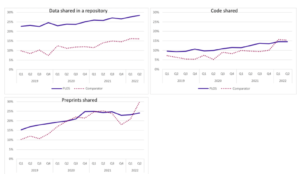
To even begin exploring these questions and others like them we need to establish a shared understanding of how we define and measure Open Science practices. We also need to understand the current state of adoption in order to track progress over time. That’s where the Open Science Indicators project comes in. PLOS conceptualized a framework.

Source: https://theplosblog.plos.org/2022/12/open-science-indicators-first-dataset/

How can this dataset be used?

Open Science Indicators are a tool with broad potential applications to many different situations and questions in research communications. Indicators can complement and support the aims of the UNESCO Open Science Monitoring Framework Working Group and meet the needs of organizations that wish to better understand Open Science practices. They can also be used to assess the impact of policy changes, like those set forth in the recent OSTP memo, across the literature—or, in the future, to parse by research discipline or subject, institution, region, or time period. They can tell us which infrastructure is used most often, and by whom.

At PLOS in particular, we hope that a better understanding of how Open Science tools and practices are applied today can help us to identify barriers, understand community norms,  better support best practices, and track changes over time.

Importantly, our intention is not for these indicators to be used as a tool for ranking journals, authors or institutions. As for every quantitative assessment of research characteristics, responsible use calls for context and multiplicity of measures (see for example The Metric Tide and Leiden Manifesto). We feel, however, that these indicators are best used as a tool for improvement.

Learn More, Review Initial Observations/Read the Complete Blog Post

Direct to Downloadable Dataset (via figshare)

Filed under: Data Files, Libraries, News, Open Access, PLOS, Public Libraries, Publishing, Reports

SHARE:

About Gary Price

Gary Price (gprice@gmail.com) is a librarian, writer, consultant, and frequent conference speaker based in the Washington D.C. metro area. He earned his MLIS degree from Wayne State University in Detroit. Price has won several awards including the SLA Innovations in Technology Award and Alumnus of the Year from the Wayne St. University Library and Information Science Program. From 2006-2009 he was Director of Online Information Services at Ask.com.


ADVERTISEMENT

Archives

Job Zone

ADVERTISEMENT

Related Infodocket Posts

ADVERTISEMENT

FOLLOW US ON X

Tweets by infoDOCKET

ADVERTISEMENT

This coverage is free for all visitors. Your support makes this possible.

This coverage is free for all visitors. Your support makes this possible.

Primary Sidebar

  • News
  • Reviews+
  • Technology
  • Programs+
  • Design
  • Leadership
  • People
  • COVID-19
  • Advocacy
  • Opinion
  • INFOdocket
  • Job Zone

Reviews+

  • Booklists
  • Prepub Alert
  • Book Pulse
  • Media
  • Readers' Advisory
  • Self-Published Books
  • Review Submissions
  • Review for LJ

Awards

  • Library of the Year
  • Librarian of the Year
  • Movers & Shakers 2022
  • Paralibrarian of the Year
  • Best Small Library
  • Marketer of the Year
  • All Awards Guidelines
  • Community Impact Prize

Resources

  • LJ Index/Star Libraries
  • Research
  • White Papers / Case Studies

Events & PD

  • Online Courses
  • In-Person Events
  • Virtual Events
  • Webcasts
  • About Us
  • Contact Us
  • Advertise
  • Subscribe
  • Media Inquiries
  • Newsletter Sign Up
  • Submit Features/News
  • Data Privacy
  • Terms of Use
  • Terms of Sale
  • FAQs
  • Careers at MSI


© 2026 Library Journal. All rights reserved.


© 2022 Library Journal. All rights reserved.