

Preprint: “Phase 1 of the NIH Preprint Pilot: Testing the Viability of Making Preprints Discoverable in PubMed Central and PubMed”
The research article (preprint) linked below was recently shared on bioRxiv.
Title
Authors
Kathryn Funk
National Center for Biotechnology Information, National Library of Medicine, National Institutes of Health
Teresa Zayas-Cabán
National Library of Medicine, National Institutes of Health
Jeffrey Beck
National Center for Biotechnology Information, National Library of Medicine, National Institutes of Health
Source
via bioRxiv
December 13, 2022
DOI: 10.1101/2022.12.12.520156
Abstract
Introduction|
The National Library of Medicine (NLM) launched a pilot in June 2020 to 1) explore the feasibility and utility of adding preprints to PubMed Central (PMC) and making them discoverable in PubMed and 2) to support accelerated discoverability of NIH-supported research without compromising user trust in NLM’s widely used literature services.
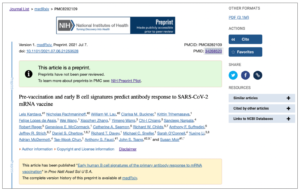
Figure 1. Screenshot of a preprint record display in PMC (PMC8282109). This example record includes green information panel identifying the record as a preprint that has not been peer reviewed, the preprint indicator in the citation, and the yellow related content information panel that points to the associated peer-reviewed journal version and preprint server. Source: 10.1101/2022.12.12.520156
Methods
The first phase of the Pilot focused on archiving preprints reporting NIH-supported SARS-CoV-2 virus and COVID-19 research. To launch Phase 1, NLM identified eligible preprint servers and developed processes for identifying NIH-supported preprints within scope in these servers. Processes were also developed for the ingest and conversion of preprints in PMC and to send corresponding records to PubMed. User interfaces were modified for display of preprint records. NLM collected data on the preprints ingested and discovery of preprint records in PMC and PubMed and engaged users through focus groups and a survey to obtain direct feedback on the Pilot and perceptions of preprints.
Results
Between June 2020 and June 2022, NLM added more than 3,300 preprint records to PMC and PubMed, which were viewed 4 million times and 3 million times, respectively. Nearly a quarter of preprints in the Pilot were not associated with a peer-reviewed published journal article. User feedback revealed that the inclusion of preprints did not have a notable impact on trust in PMC or PubMed.
Discussion
NIH-supported preprints can be identified and added to PMC and PubMed without disrupting existing operations processes. Additionally, inclusion of preprints in PMC and PubMed accelerates discovery of NIH research without reducing trust in NLM literature services. Phase 1 of the Pilot provided a useful testbed for studying NIH investigator preprint posting practices, as well as knowledge gaps among user groups, during the COVID-19 public health emergency, an unusual time with heightened interest in immediate access to research results.
Direct to Full Text Article
22 pages; PDF.
Filed under: Data Files, Libraries, National Libraries, News, Patrons and Users

About Gary Price
Gary Price (gprice@gmail.com) is a librarian, writer, consultant, and frequent conference speaker based in the Washington D.C. metro area. He earned his MLIS degree from Wayne State University in Detroit. Price has won several awards including the SLA Innovations in Technology Award and Alumnus of the Year from the Wayne St. University Library and Information Science Program. From 2006-2009 he was Director of Online Information Services at Ask.com.
ADVERTISEMENT
Archives

ADVERTISEMENT