

Folger Shakespeare Library Announces Official Release of New Online Catalog Powered by TIND
From The Collation by Julie Swierczek:
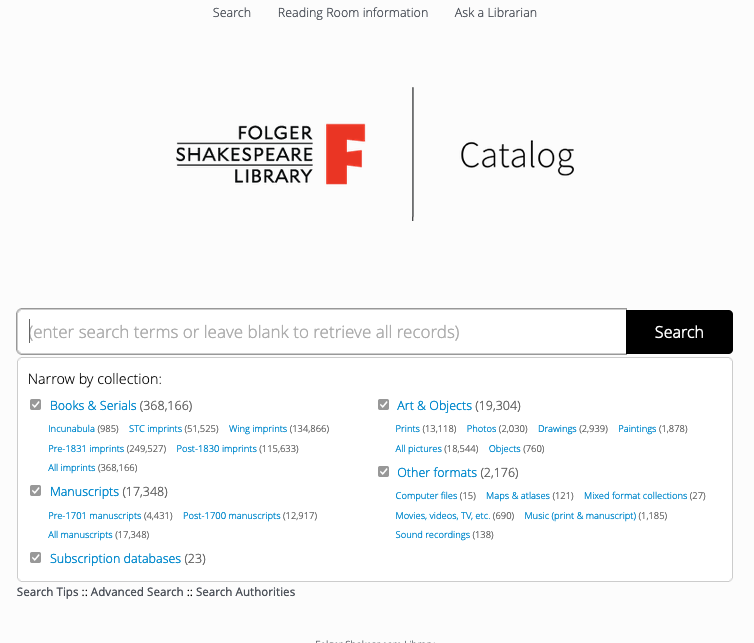
In April we announced the preview of our new catalog, and now it is time to make it official: the new catalog is here! Visit it at https://catalog.folger.edu/.
The new catalog is powered by the TIND ILS (Integrated Library System). TIND is an official spin-off of CERN, the European Organization for Nuclear Research.1 While CERN is most famous for being the home of the Large Hadron Collider, the world’s largest and highest-energy particle collider, it is also a center for research and experimentation in information organization and exchange. Tim Berners-Lee and Robert Cailliau invented what would become the World Wide Web while working at CERN!
[Clip]
If you’re curious about how we finally arrived at TIND as a replacement for the ILS we’ve used for the last twenty-five years,2 the answer is that we spent several months writing a requirements document detailing what we needed in a new ILS. It was 28 pages long, with 311 requirements and 36 questions. While we knew no system would likely meet every requirement, the document helped us focus our attention on systems that were best suited for our needs.
Selecting a new ILS was challenging because of the richness of the Folger’s bibliographic data. See, for instance, this record, or this one, or perhaps this one.3 While many people come to the Folger to do research with items in our collections, many librarians refer to the Folger’s bibliographic data to learn more about how rare materials (books, manuscripts, graphics, etc.) are cataloged.4 We needed to make sure that a new ILS could work with, and make the most of, the richness of our data.
[Clip]
In the coming weeks and months, we will be working on instructional materials so that users can take advantage of the many features of the new catalog. We’ve started a page in Folgerpedia about the catalog. We’ll also be keeping track of the development of some key features there. Until we have developed Folger-specific guides about catalog features, we invite you to check out the following resources and features.
Some features, such as creating ‘baskets’ of results or subscribing to updates for search results, require a user account. Most current Folger readers will already have an account. Go to https://catalog.folger.edu/, click “login” in the upper right, then click “Forgot password” and enter your email address. If you’re already a Folger reader and the catalog claims your email address does not exist in the database, send email to catalog@folger.edu and we’ll fix it. If you’re not registered as a Folger reader, and you would like an account, contact catalog@folger.edu and we’ll create a catalog account for you. Everyone is welcome to have one; accounts are not just for people who intend to use the library in person!
TIND has a general search guide for the catalog: https://catalog.folger.edu/docs/sea60rch-guide/ (which can also be reached by clicking on “search tips” under the search box). Be sure to check out the Advanced Search. It’s even possible to search by regular expressions!
Learn More, Read the Complete Blog Post (about 2060 Words)
Filed under: Data Files, Libraries, News, Patrons and Users

About Gary Price
Gary Price (gprice@gmail.com) is a librarian, writer, consultant, and frequent conference speaker based in the Washington D.C. metro area. He earned his MLIS degree from Wayne State University in Detroit. Price has won several awards including the SLA Innovations in Technology Award and Alumnus of the Year from the Wayne St. University Library and Information Science Program. From 2006-2009 he was Director of Online Information Services at Ask.com.
ADVERTISEMENT
Archives

ADVERTISEMENT