

Research Tools: Comprehensive Database of Mass Shooters Released for Public Use
From Hamline University:
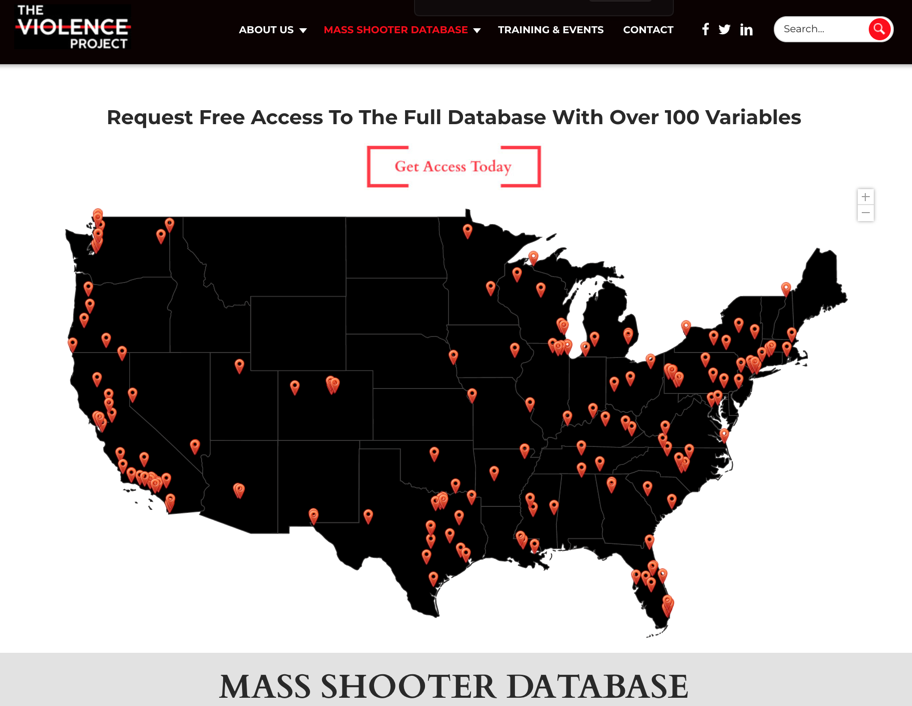
The Violence Project, a nonpartisan think tank, have publicly released the largest, most comprehensive database of mass shooters in the United States.
This new database, funded by the National Institute of Justice, the research arm of the U.S. Department of Justice, was developed by professors Jillian Peterson and James Densley and a team of students at Hamline University in St. Paul, Minnesota. It includes 171 mass shooters from 1966 to 2019, each coded on 100 pieces of life history information. The entire database is downloadable for free at The Violence Project website.
[Clip]
This database is the first to look closely at the mental health histories of mass shooters. Among the 171 mass shooters, two-thirds had a mental health diagnosis or presented mental health concerns. This is only slightly higher than the fifty percent of people in the general population who will meet criteria for a mental illness in their lifetime. However, a mental health diagnosis does not mean that the actions of mass shooters are directly motivated by their symptoms. The database shows that sixteen percent of mass shootings are at least partly motivated by psychosis – which is less than the percentage that of shootings motivated by domestic issues, employment changes, interpersonal issues, and hate.
This is also the first database to look closely at how many shooters obtained their guns. The majority of mass shooters use handguns (seventy-seven percent) and twenty-five percent used assault rifles. Of the known data, seventy-seven percent of shooters purchased at least some of their guns legally, thirteen percent made illegal purchases, and nineteen percent stole guns.
Direct to Complete Announcement
Direct to Database
Media Coverage: Minnesota-Made Tool Tracks the How and Why Behind Mass Shootings (via Minnesota Public Radio)
Filed under: Data Files, News

About Gary Price
Gary Price (gprice@gmail.com) is a librarian, writer, consultant, and frequent conference speaker based in the Washington D.C. metro area. He earned his MLIS degree from Wayne State University in Detroit. Price has won several awards including the SLA Innovations in Technology Award and Alumnus of the Year from the Wayne St. University Library and Information Science Program. From 2006-2009 he was Director of Online Information Services at Ask.com.
ADVERTISEMENT
Archives

ADVERTISEMENT