

Research Tools: New Interactive Map Reveals That Lynching Extended Far Beyond The Deep South
From Penn St. University:
An interactive map of lynchings that occurred in the United States from 1883 to 1941 reveals not just the extent of mob violence, but also underscores how the roles of economy, topography and law enforcement infrastructure paved the way for these brutal, violent outbursts, according to researchers.
Although often thought of as unique to states in the southern U.S., lynching was practiced across the country and, although Southern blacks were by far the most common victim, the violence left few races and ethnic groups unscathed, said Charles Seguin, Penn State assistant professor of sociology and social data analytics and an affiliate of Penn State’s Institute for CyberScience. He added that slavery and racism’s effect on this mob violence is deeply etched into the patterns of lynching displayed on the map, but lynching also occurred in Northern states, which had abolished slavery long before the Civil War.
[Clip]
The researchers drew on data collected by the NAACP and Chicago Tribune of lynchings that were reported in the contiguous U.S. from 1883 to 1941, as well as data from lists published by historians. Of the 4,467 people who were listed as victims of lynching, 3,265 were black, 1,082 were white, 71 were Mexican or of Mexican descent, and 38 were American Indian. The researchers confirmed the data collected by the Chicago Tribune and by the NAACP by verifying the accounts in local newspapers. They also used the newspaper accounts to estimate the mob size and determine the race and gender of the victim, alleged offense that incited the mob, and the method of murder.
[Clip]
The data for this study is available on the researcher’s website.
Future research may look at how certain lynching events served as a springboard for legal changes and shifts in public opinion on mob violence, said Seguin.
The National Science Foundation supported this work.
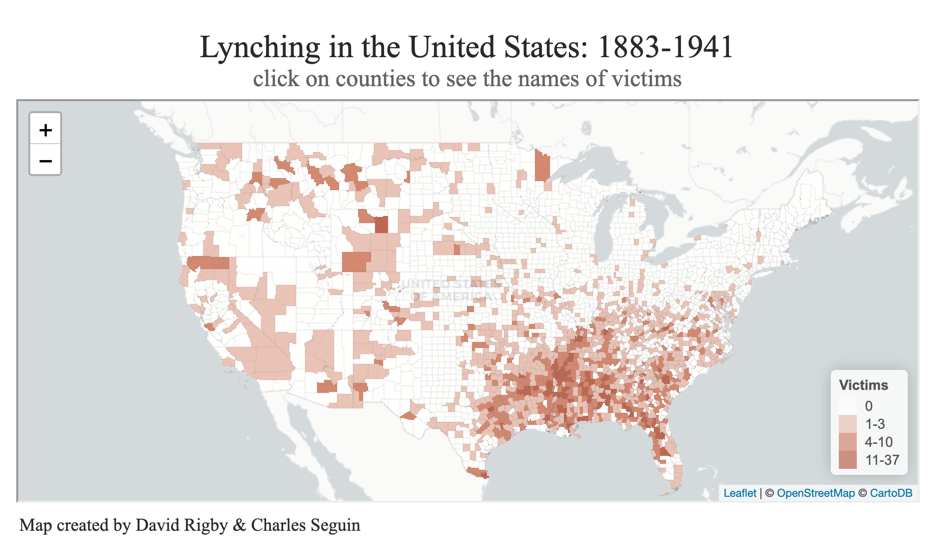
Direct to Interactive Map
Read the Complete PSU Announcement
Filed under: Data Files, News

About Gary Price
Gary Price (gprice@gmail.com) is a librarian, writer, consultant, and frequent conference speaker based in the Washington D.C. metro area. He earned his MLIS degree from Wayne State University in Detroit. Price has won several awards including the SLA Innovations in Technology Award and Alumnus of the Year from the Wayne St. University Library and Information Science Program. From 2006-2009 he was Director of Online Information Services at Ask.com.
ADVERTISEMENT
Archives

ADVERTISEMENT