
Ithaka S+R Publishes Results of US Faculty Survey 2018
From the Introduction and Executive Summary of the Report:
The Ithaka S+R US Faculty Survey has tracked the changing research, teaching, and publishing practices of higher education faculty members on a triennial basis since 2000. Our aim in this project is to provide actionable findings and analysis to help colleges and universities as well as relevant support services, such as academic libraries, learned societies, and scholarly publishers, plan for the future.
In this seventh triennial cycle, we surveyed a random sample of faculty within the United States on topics from previous cycles, including information discovery and access, data management, research dissemination, perceptions of student research skills, and the value of the library. We also added new questions on emerging topics of interest, including open educational resources, learning analytics, and evolving scholarly communication models. Given the levels of response to the survey, findings can be analyzed by discipline, institution type, and other important demographic characteristics. The key findings below highlight many of the most notable results from the 2018 US Faculty Survey
Executive Summary of Key Findings
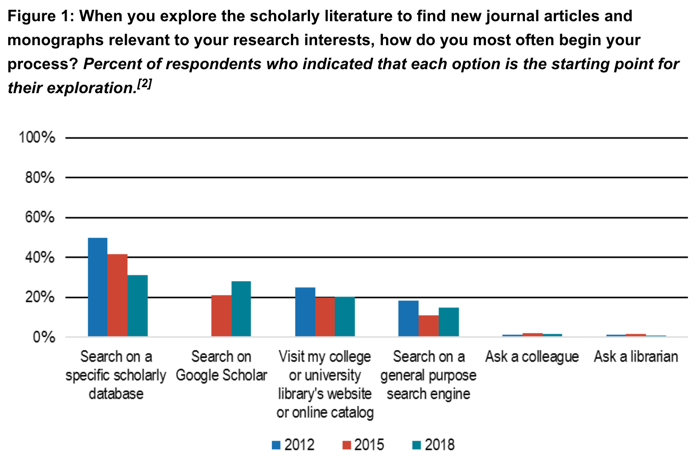
Discovery starting points are shifting towards Google Scholar and other general search engines. While specific scholarly databases remain the most frequent starting point for research, faculty are increasingly beginning their exploration of scholarly literature with Google Scholar and other general-purpose search engines.
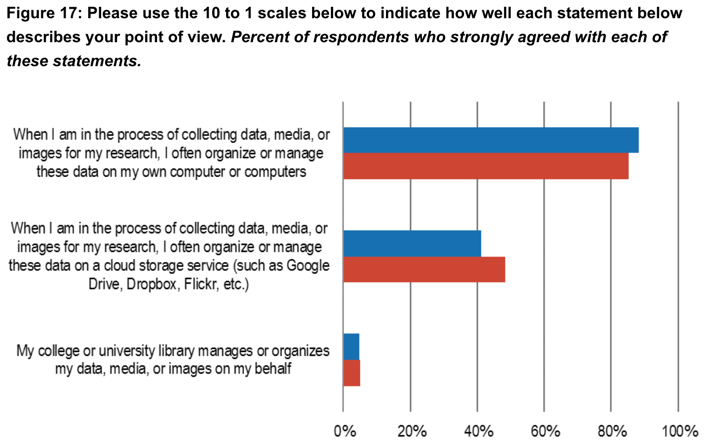
- Faculty members increasingly prefer to manage and preserve their data using cloud-based storage services. Since the previous cycle of the survey, a greater share of faculty report use of cloud-based storage services, such as Google Drive, Dropbox, and Flickr, to organize, manage, and preserve their research data, media, or images. Faculty also report file hosting services, such as Box and Dropbox, as the most valuable source of support for managing and preserving these data compared to other sources.
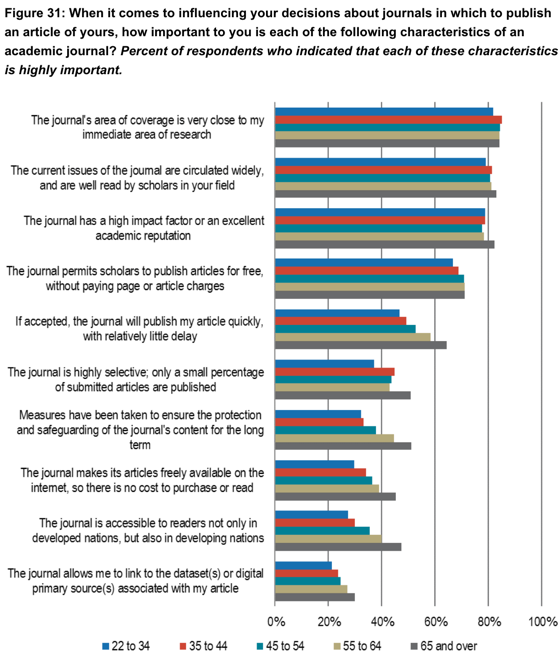
- While faculty are increasingly interested in an open access publication model, traditional scholarly incentives continue to motivate their decision-making. Approximately two-thirds of respondents in this survey cycle indicated they would be happy to see the traditional subscription-based publication model replaced entirely by an open access system, which represents a greater share of respondents compared to the previous survey cycle. However, only four in ten faculty indicate open access characteristics of journals as highly influential in publication decisions.
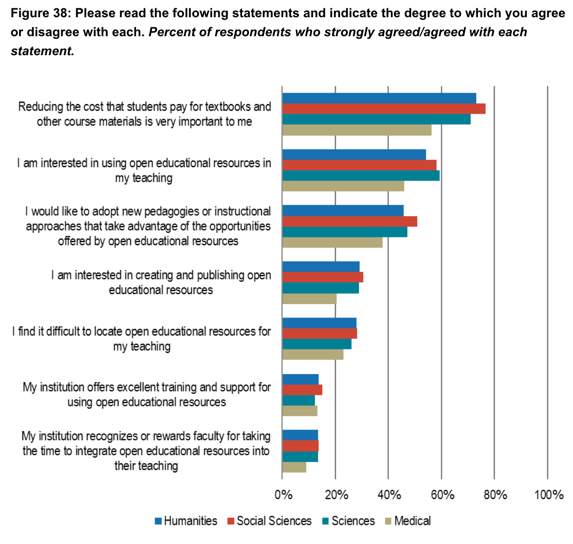
- There is substantial interest in use of open educational resources for instructional practices, particularly from younger faculty members. About six in ten respondents are very interested in using open educational resources (OER), and roughly half strongly agreed that they would like to adopt new instructional approaches with OER.
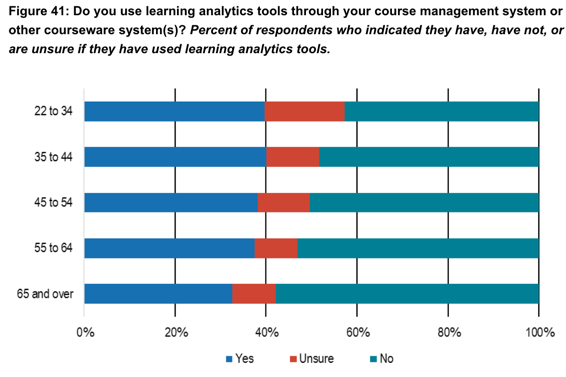
- Faculty are skeptical about the value of using learning analytics tools. While faculty who have used learning analytics tools are more likely to agree that these tools could make a substantial impact on their teaching practices and outcomes, survey respondents across the board do not hold especially positive views of these tools.
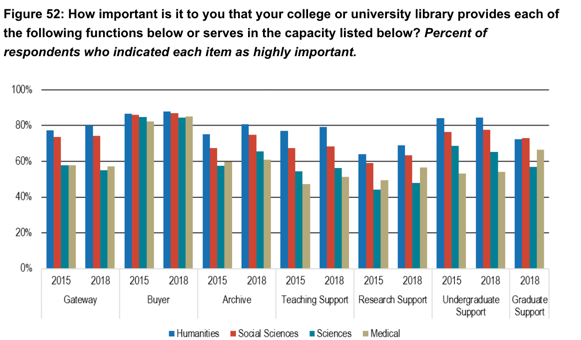
- The role of the library in archiving materials is increasingly important. While faculty maintain that the library’s most important function is as the buyer of resources they need, they are finding the library’s ability to serve as a repository of resources increasingly important.
Direct to Full Text Report
Direct to PDF Version
70 pages.
See Also: Previous Edition of US Faculty Survey (2015)
Filed under: Academic Libraries, Companies (Publishers/Vendors), Data Files, Libraries, Management and Leadership, News, Open Access, Publishing

About Gary Price
Gary Price (gprice@gmail.com) is a librarian, writer, consultant, and frequent conference speaker based in the Washington D.C. metro area. He earned his MLIS degree from Wayne State University in Detroit. Price has won several awards including the SLA Innovations in Technology Award and Alumnus of the Year from the Wayne St. University Library and Information Science Program. From 2006-2009 he was Director of Online Information Services at Ask.com.
ADVERTISEMENT
Archives
ADVERTISEMENT