SUBSCRIBE
SUBSCRIBE
EXPLORE +
  • About infoDOCKET
  • Academic Libraries on LJ
  • Research on LJ
  • News on LJ
  • Skip to primary navigation
  • Skip to main content
  • Skip to primary sidebar
  • Libraries
    • Academic Libraries
    • Government Libraries
    • National Libraries
    • Public Libraries
  • Companies (Publishers/Vendors)
    • EBSCO
    • Elsevier
    • Ex Libris
    • Frontiers
    • Gale
    • PLOS
    • Scholastic
  • New Resources
    • Dashboards
    • Data Files
    • Digital Collections
    • Digital Preservation
    • Interactive Tools
    • Maps
    • Other
    • Podcasts
    • Productivity
  • New Research
    • Conference Presentations
    • Journal Articles
    • Lecture
    • New Issue
    • Reports
  • Topics
    • Archives & Special Collections
    • Associations & Organizations
    • Awards
    • Funding
    • Interviews
    • Jobs
    • Management & Leadership
    • News
    • Patrons & Users
    • Preservation
    • Profiles
    • Publishing
    • Roundup
    • Scholarly Communications
      • Open Access

April 9, 2019 by Gary Price

Updated: Public Attitudes Toward Censorship of Particular Book Topics (1972-2016)

April 9, 2019 by Gary Price

From Humanities Indicators/American Academy of Arts and Sciences:

Weighing conflicting points of view to arrive at reasoned conclusions is a key humanistic competency, and Americans’ willingness to permit the public dissemination of texts that they find personally objectionable can serve as one marker of this capacity.

Findings and Trends

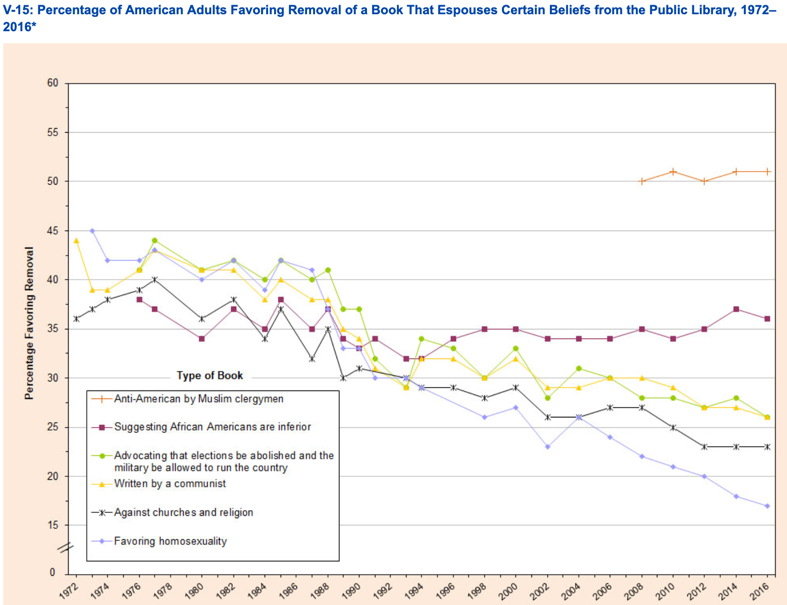
  • In 2016, Americans were less supportive of suppressing most types of texts than they were in the early 1970s, even though a nonnegligible minority of Americans still supported censorship of this kind (Indicator V-15). The greatest decline, 28 percentage points, was in the share of Americans willing to suppress books advocating homosexuality.
Source: Humanities Indicators 2019/American Academy of Arts and Sciences
  • An exception to declining support for the removal from libraries of books on particular topics is texts asserting the inferiority of African Americans. The level of disapproval for this sort of text varied within a very narrow band over four decades. In 1976, 38% of American adults favored removal. In 2016, the share was 36%.
  • Data on Americans’ willingness to allow books by Muslim clergymen with an anti-American message are available going back only as far as 2008, but they reveal that approximately half of Americans—a considerably larger share than for any other type of material examined here—favor removal of such books from libraries.

Source: NORC at the University of Chicago, General Social Survey (1972–2016). Data analyzed by the American Academy’s Humanities Indicators  using the GSS Data Explorer.

Filed under: Data Files, Libraries, News

SHARE:

About Gary Price

Gary Price (gprice@gmail.com) is a librarian, writer, consultant, and frequent conference speaker based in the Washington D.C. metro area. He earned his MLIS degree from Wayne State University in Detroit. Price has won several awards including the SLA Innovations in Technology Award and Alumnus of the Year from the Wayne St. University Library and Information Science Program. From 2006-2009 he was Director of Online Information Services at Ask.com.

ADVERTISEMENT

Archives

Job Zone

ADVERTISEMENT

Related Infodocket Posts

ADVERTISEMENT

FOLLOW US ON X

Tweets by infoDOCKET

ADVERTISEMENT

This coverage is free for all visitors. Your support makes this possible.

This coverage is free for all visitors. Your support makes this possible.

Primary Sidebar

  • News
  • Reviews+
  • Technology
  • Programs+
  • Design
  • Leadership
  • People
  • COVID-19
  • Advocacy
  • Opinion
  • INFOdocket
  • Job Zone

Reviews+

  • Booklists
  • Prepub Alert
  • Book Pulse
  • Media
  • Readers' Advisory
  • Self-Published Books
  • Review Submissions
  • Review for LJ

Awards

  • Library of the Year
  • Librarian of the Year
  • Movers & Shakers 2022
  • Paralibrarian of the Year
  • Best Small Library
  • Marketer of the Year
  • All Awards Guidelines
  • Community Impact Prize

Resources

  • LJ Index/Star Libraries
  • Research
  • White Papers / Case Studies

Events & PD

  • Online Courses
  • In-Person Events
  • Virtual Events
  • Webcasts
  • About Us
  • Contact Us
  • Advertise
  • Subscribe
  • Media Inquiries
  • Newsletter Sign Up
  • Submit Features/News
  • Data Privacy
  • Terms of Use
  • Terms of Sale
  • FAQs
  • Careers at MSI


© 2026 Library Journal. All rights reserved.


© 2022 Library Journal. All rights reserved.