

Health: Interactive Research Tool: “New Data Provides a Deeper Understanding of Life Expectancy Gaps”
From the Robert Wood Johnson Foundation Blog Post:
The more local the data, the more useful it is for pinpointing disparities and driving action. The first universal measure of health at a neighborhood level reveals gaps that may previously have gone unnoticed.
That is why today’s release of life expectancy estimates by census tract is so exciting. This first-of-its-kind data, compiled by the United States Small-Area Life Expectancy Estimate Project (USALEEP), is the first time life expectancy at birth estimates are available nationwide down to the neighborhood level for virtually every community in America.
[Clip]
USALEEP, the first universal measure of health at the neighborhood level, clearly reveals gaps that may previously have gone unnoticed. In doing so, it promotes conversations at the hyper-local level about resource allocation and health equity. Community leaders can pair this data with existing county-level and city-level data to allocate resources where they may be most needed in order to support healthier, more equitable communities.
[Clip]
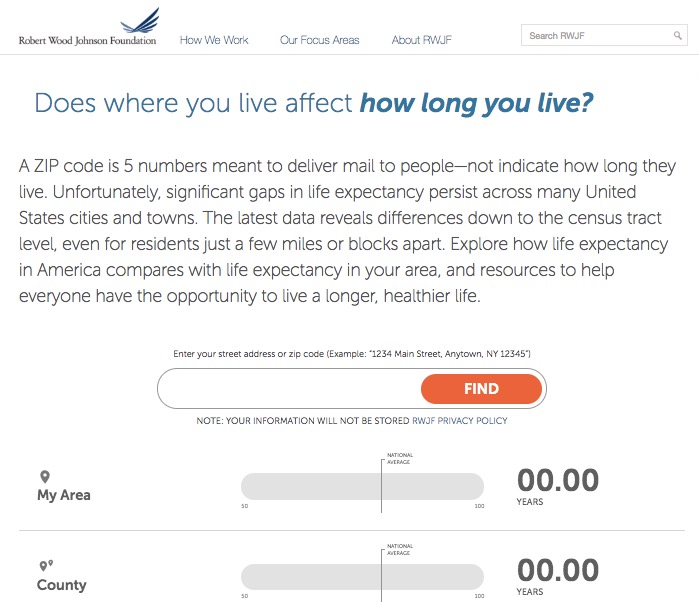
These new data are available to everyone via the easy-to-use interactive tool available above. Typing in your street address reveals the average life expectancy for a baby born in your census tract or area, if current death rates do not change. You can then compare your area to nearby neighborhoods or communities, to county- and state-level data, as well as the national average. If you have a neighbor down the street who happens to live in a different census tract, your results might even be different, which we hope will spark some conversation about the differences in conditions and opportunities for health where we live. Ultimately, we hope this will inspire residents and leaders to work together to close the gaps these data illuminate.
Learn Much More, Read the Complete Blog Post
Direct to Interactive Data Tool: “Does Where You Live Affect How Long You Live?”
See Also: County Health Rankings (via RWJF)
See Also: The New “City Health Dashboard” Provides Access to Key Neighborhood-Level Health Data For the 500 Largest U.S. Cities
Coverage
UPDATE (September 21, 2018) Two Places in Maryland Where People Can Expect to Live Longer, on Average, Than Almost Anywhere Else in the U.S. (via WaPo)
UPDATE (September 14, 2018) The Strawberry Capital of the World is the Early Death Capital of the U.S.: Lessons From a Landmark Dataset
Filed under: Data Files, News

About Gary Price
Gary Price (gprice@gmail.com) is a librarian, writer, consultant, and frequent conference speaker based in the Washington D.C. metro area. He earned his MLIS degree from Wayne State University in Detroit. Price has won several awards including the SLA Innovations in Technology Award and Alumnus of the Year from the Wayne St. University Library and Information Science Program. From 2006-2009 he was Director of Online Information Services at Ask.com.
ADVERTISEMENT
Archives

ADVERTISEMENT