SUBSCRIBE
SUBSCRIBE
EXPLORE +
  • About infoDOCKET
  • Academic Libraries on LJ
  • Research on LJ
  • News on LJ
  • Skip to primary navigation
  • Skip to main content
  • Skip to primary sidebar
  • Libraries
    • Academic Libraries
    • Government Libraries
    • National Libraries
    • Public Libraries
  • Companies (Publishers/Vendors)
    • EBSCO
    • Elsevier
    • Ex Libris
    • Frontiers
    • Gale
    • PLOS
    • Scholastic
  • New Resources
    • Dashboards
    • Data Files
    • Digital Collections
    • Digital Preservation
    • Interactive Tools
    • Maps
    • Other
    • Podcasts
    • Productivity
  • New Research
    • Conference Presentations
    • Journal Articles
    • Lecture
    • New Issue
    • Reports
  • Topics
    • Archives & Special Collections
    • Associations & Organizations
    • Awards
    • Funding
    • Interviews
    • Jobs
    • Management & Leadership
    • News
    • Patrons & Users
    • Preservation
    • Profiles
    • Publishing
    • Roundup
    • Scholarly Communications
      • Open Access

April 24, 2017 by Gary Price

Reference: New Report/Data Analysis: “The Debt Burden of Bachelor’s Degree Recipients”

April 24, 2017 by Gary Price

New From the National Center for Education Statistics:

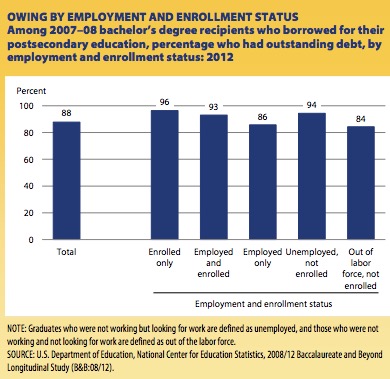
Approximately 72 percent of 2007-08 bachelor’s degree recipients had borrowed to pay for their postsecondary education (either undergraduate or graduate), and 63 percent of bachelor’s degree recipients still had student loan debt 4 years after completing their degree.

2017-04-24_11-37-06
Source: The Debt Burden of Bachelor’s Degree Recipients (2017)(NCES)

The National Center for Education Statistics released a new Statistics in Brief report entitled The Debt Burden of Bachelor’s Degree Recipients. The report explores student loan repayment and outstanding debt for 2007-08 bachelor’s degree recipients 4 years after graduation, as well as how these loan repayment outcomes varied by employment and further degree enrollment. The study found that:

  • Among borrowers with no additional postsecondary enrollment, 69 percent were repaying their loans 4 years after graduation, while 17 percent had paid off their loans, 9 percent were not paying but still owed, and 5 percent had defaulted;
  • Borrowers who had no postsecondary enrollment after completing their bachelor’s degree owed an average of $24,200, and those who had borrowed for further postsecondary education owed an average of $61,300; and
  • Among borrowers who were in repayment, employed, and had no further enrollment, their average debt burden (monthly loan payment as a percent of monthly salary) was 10 percent. About 22 percent of this group carried a debt burden over 12 percent.

The data used in this study are drawn from the Baccalaureate and Beyond Longitudinal Study, a nationally representative, longitudinal survey of students who completed the requirements for a bachelor’s degree during the 2007–08 academic year.

Direct to Full Text Report (40 Pages; PDF)

Filed under: Data Files, News

SHARE:

About Gary Price

Gary Price (gprice@gmail.com) is a librarian, writer, consultant, and frequent conference speaker based in the Washington D.C. metro area. He earned his MLIS degree from Wayne State University in Detroit. Price has won several awards including the SLA Innovations in Technology Award and Alumnus of the Year from the Wayne St. University Library and Information Science Program. From 2006-2009 he was Director of Online Information Services at Ask.com.


ADVERTISEMENT

Archives

Job Zone

ADVERTISEMENT

Related Infodocket Posts

ADVERTISEMENT

FOLLOW US ON X

Tweets by infoDOCKET

ADVERTISEMENT

This coverage is free for all visitors. Your support makes this possible.

This coverage is free for all visitors. Your support makes this possible.

Primary Sidebar

  • News
  • Reviews+
  • Technology
  • Programs+
  • Design
  • Leadership
  • People
  • COVID-19
  • Advocacy
  • Opinion
  • INFOdocket
  • Job Zone

Reviews+

  • Booklists
  • Prepub Alert
  • Book Pulse
  • Media
  • Readers' Advisory
  • Self-Published Books
  • Review Submissions
  • Review for LJ

Awards

  • Library of the Year
  • Librarian of the Year
  • Movers & Shakers 2022
  • Paralibrarian of the Year
  • Best Small Library
  • Marketer of the Year
  • All Awards Guidelines
  • Community Impact Prize

Resources

  • LJ Index/Star Libraries
  • Research
  • White Papers / Case Studies

Events & PD

  • Online Courses
  • In-Person Events
  • Virtual Events
  • Webcasts
  • About Us
  • Contact Us
  • Advertise
  • Subscribe
  • Media Inquiries
  • Newsletter Sign Up
  • Submit Features/News
  • Data Privacy
  • Terms of Use
  • Terms of Sale
  • FAQs
  • Careers at MSI


© 2026 Library Journal. All rights reserved.


© 2022 Library Journal. All rights reserved.