SUBSCRIBE
SUBSCRIBE
EXPLORE +
  • About infoDOCKET
  • Academic Libraries on LJ
  • Research on LJ
  • News on LJ
  • Skip to primary navigation
  • Skip to main content
  • Skip to primary sidebar
  • Libraries
    • Academic Libraries
    • Government Libraries
    • National Libraries
    • Public Libraries
  • Companies (Publishers/Vendors)
    • EBSCO
    • Elsevier
    • Ex Libris
    • Frontiers
    • Gale
    • PLOS
    • Scholastic
  • New Resources
    • Dashboards
    • Data Files
    • Digital Collections
    • Digital Preservation
    • Interactive Tools
    • Maps
    • Other
    • Podcasts
    • Productivity
  • New Research
    • Conference Presentations
    • Journal Articles
    • Lecture
    • New Issue
    • Reports
  • Topics
    • Archives & Special Collections
    • Associations & Organizations
    • Awards
    • Funding
    • Interviews
    • Jobs
    • Management & Leadership
    • News
    • Patrons & Users
    • Preservation
    • Profiles
    • Publishing
    • Roundup
    • Scholarly Communications
      • Open Access

August 10, 2016 by Gary Price

New: NTIA Data and Analysis on “State of the Urban/Rural Digital Divide”

August 10, 2016 by Gary Price

From the National Telecommunications and Information Administration (NTIA):

While 75 percent of Americans reported using the Internet in July 2015, the longstanding disparity between urban and rural users persists and has emerged in the adoption of new technologies such as the smartphone and social media, according to the latest computer and Internet use data collected for NTIA. This suggests that in spite of advances in both policy and technology, the barriers to Internet adoption existing in rural communities are complex and stubborn.
In particular, Americans who were otherwise less likely to use the Internet—such as those with lower levels of family income or education—faced an even larger disadvantage when living in a rural area. Conversely, rural individuals with higher levels of education or family income did not have significantly lower adoption rates than their urban counterparts, according to the data. The data comes from NTIA’s Computer and Internet Use Supplement to the Census Bureau’s Current Population Survey.
[Clip]
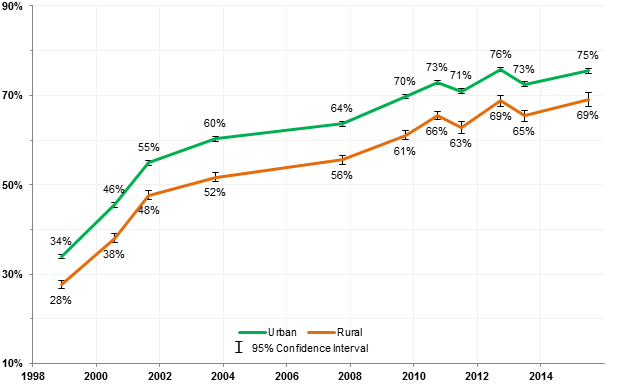
While the digital divide appears to be closing for some demographic communities, the gap between rural and urban populations has remained remarkably consistent for at least as long as NTIA has been gathering data on Internet use. In 1998, 28 percent of Americans living in rural areas used the Internet, compared to 34 percent of those in urban areas. Even as Internet use increased dramatically overall, a rural/urban gap remained in 2015, with 69 percent of rural residents reporting using the Internet, versus 75 percent of urban residents. This data indicates a fairly constant 6-9 percentage point gap between rural and urban communities’ Internet use over time.

The State of the Urban/Rural Digital Divide
Internet Use from Any Location by Population Density Percent of Americans Ages 3+, 1998-2015 Source: NTIA Blog (August 10, 2016)

Read the Complete NTIA Blog Post and View Three Additional Charts

Filed under: Data Files, News, Patrons and Users

SHARE:

About Gary Price

Gary Price (gprice@gmail.com) is a librarian, writer, consultant, and frequent conference speaker based in the Washington D.C. metro area. He earned his MLIS degree from Wayne State University in Detroit. Price has won several awards including the SLA Innovations in Technology Award and Alumnus of the Year from the Wayne St. University Library and Information Science Program. From 2006-2009 he was Director of Online Information Services at Ask.com.


ADVERTISEMENT

Archives

Job Zone

ADVERTISEMENT

Related Infodocket Posts

ADVERTISEMENT

FOLLOW US ON X

Tweets by infoDOCKET

ADVERTISEMENT

This coverage is free for all visitors. Your support makes this possible.

This coverage is free for all visitors. Your support makes this possible.

Primary Sidebar

  • News
  • Reviews+
  • Technology
  • Programs+
  • Design
  • Leadership
  • People
  • COVID-19
  • Advocacy
  • Opinion
  • INFOdocket
  • Job Zone

Reviews+

  • Booklists
  • Prepub Alert
  • Book Pulse
  • Media
  • Readers' Advisory
  • Self-Published Books
  • Review Submissions
  • Review for LJ

Awards

  • Library of the Year
  • Librarian of the Year
  • Movers & Shakers 2022
  • Paralibrarian of the Year
  • Best Small Library
  • Marketer of the Year
  • All Awards Guidelines
  • Community Impact Prize

Resources

  • LJ Index/Star Libraries
  • Research
  • White Papers / Case Studies

Events & PD

  • Online Courses
  • In-Person Events
  • Virtual Events
  • Webcasts
  • About Us
  • Contact Us
  • Advertise
  • Subscribe
  • Media Inquiries
  • Newsletter Sign Up
  • Submit Features/News
  • Data Privacy
  • Terms of Use
  • Terms of Sale
  • FAQs
  • Careers at MSI


© 2026 Library Journal. All rights reserved.


© 2022 Library Journal. All rights reserved.