SUBSCRIBE
SUBSCRIBE
EXPLORE +
  • About infoDOCKET
  • Academic Libraries on LJ
  • Research on LJ
  • News on LJ
  • Skip to primary navigation
  • Skip to main content
  • Skip to primary sidebar
  • Libraries
    • Academic Libraries
    • Government Libraries
    • National Libraries
    • Public Libraries
  • Companies (Publishers/Vendors)
    • EBSCO
    • Elsevier
    • Ex Libris
    • Frontiers
    • Gale
    • PLOS
    • Scholastic
  • New Resources
    • Dashboards
    • Data Files
    • Digital Collections
    • Digital Preservation
    • Interactive Tools
    • Maps
    • Other
    • Podcasts
    • Productivity
  • New Research
    • Conference Presentations
    • Journal Articles
    • Lecture
    • New Issue
    • Reports
  • Topics
    • Archives & Special Collections
    • Associations & Organizations
    • Awards
    • Funding
    • Interviews
    • Jobs
    • Management & Leadership
    • News
    • Patrons & Users
    • Preservation
    • Profiles
    • Publishing
    • Roundup
    • Scholarly Communications
      • Open Access

March 24, 2016 by Gary Price

Science: New NASA Gravity Map Gives Best View Yet Inside Mars

March 24, 2016 by Gary Price

From NASA:

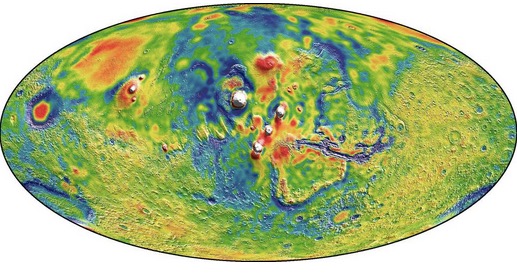
2016-03-24_12-23-06
Source: via NASA Goddard

A new map of Mars’ gravity made with three NASA spacecraft is the most detailed to date, providing a revealing glimpse into the hidden interior of the Red Planet.”Gravity maps allow us to see inside a planet, just as a doctor uses an X-ray to see inside a patient,” said Antonio Genova of the Massachusetts Institute of Technology (MIT), Cambridge, Massachusetts. “The new gravity map will be helpful for future Mars exploration, because better knowledge of the planet’s gravity anomalies helps mission controllers insert spacecraft more precisely into orbit about Mars. Furthermore, the improved resolution of our gravity map will help us understand the still-mysterious formation of specific regions of the planet.” Genova, who is affiliated with MIT but is located at NASA’s Goddard Space Flight Center in Greenbelt, Maryland, is the lead author of a paper on this research published online March 5 in the journal Icarus.
[Clip]
The map was derived using Doppler and range tracking data collected by NASA’s Deep Space Network from three NASA spacecraft in orbit around Mars: Mars Global Surveyor (MGS), Mars Odyssey (ODY), and the Mars Reconnaissance Orbiter (MRO). Like all planets, Mars is lumpy, which causes the gravitational pull felt by spacecraft in orbit around it to change. For example, the pull will be a bit stronger over a mountain, and slightly weaker over a canyon.

Read the Complete Report, View Video (Also Embedded), View Map
Direct to Multiple Hi-Res Visualizations (via NASA Visualizations Studio)

Filed under: Data Files, Journal Articles, Maps, News

SHARE:

About Gary Price

Gary Price (gprice@gmail.com) is a librarian, writer, consultant, and frequent conference speaker based in the Washington D.C. metro area. He earned his MLIS degree from Wayne State University in Detroit. Price has won several awards including the SLA Innovations in Technology Award and Alumnus of the Year from the Wayne St. University Library and Information Science Program. From 2006-2009 he was Director of Online Information Services at Ask.com.


ADVERTISEMENT

Archives

Job Zone

ADVERTISEMENT

Related Infodocket Posts

ADVERTISEMENT

FOLLOW US ON X

Tweets by infoDOCKET

ADVERTISEMENT

This coverage is free for all visitors. Your support makes this possible.

This coverage is free for all visitors. Your support makes this possible.

Primary Sidebar

  • News
  • Reviews+
  • Technology
  • Programs+
  • Design
  • Leadership
  • People
  • COVID-19
  • Advocacy
  • Opinion
  • INFOdocket
  • Job Zone

Reviews+

  • Booklists
  • Prepub Alert
  • Book Pulse
  • Media
  • Readers' Advisory
  • Self-Published Books
  • Review Submissions
  • Review for LJ

Awards

  • Library of the Year
  • Librarian of the Year
  • Movers & Shakers 2022
  • Paralibrarian of the Year
  • Best Small Library
  • Marketer of the Year
  • All Awards Guidelines
  • Community Impact Prize

Resources

  • LJ Index/Star Libraries
  • Research
  • White Papers / Case Studies

Events & PD

  • Online Courses
  • In-Person Events
  • Virtual Events
  • Webcasts
  • About Us
  • Contact Us
  • Advertise
  • Subscribe
  • Media Inquiries
  • Newsletter Sign Up
  • Submit Features/News
  • Data Privacy
  • Terms of Use
  • Terms of Sale
  • FAQs
  • Careers at MSI


© 2026 Library Journal. All rights reserved.


© 2022 Library Journal. All rights reserved.