

SUBSCRIBE
SUBSCRIBE
EXPLORE +
  • About infoDOCKET
  • Academic Libraries on LJ
  • Research on LJ
  • News on LJ
  • Skip to primary navigation
  • Skip to main content
  • Skip to primary sidebar
  • Libraries
    • Academic Libraries
    • Government Libraries
    • National Libraries
    • Public Libraries
  • Companies (Publishers/Vendors)
    • EBSCO
    • Elsevier
    • Ex Libris
    • Frontiers
    • Gale
    • PLOS
    • Scholastic
  • New Resources
    • Dashboards
    • Data Files
    • Digital Collections
    • Digital Preservation
    • Interactive Tools
    • Maps
    • Other
    • Podcasts
    • Productivity
  • New Research
    • Conference Presentations
    • Journal Articles
    • Lecture
    • New Issue
    • Reports
  • Topics
    • Archives & Special Collections
    • Associations & Organizations
    • Awards
    • Funding
    • Interviews
    • Jobs
    • Management & Leadership
    • News
    • Patrons & Users
    • Preservation
    • Profiles
    • Publishing
    • Roundup
    • Scholarly Communications
      • Open Access

March 5, 2014 by Gary Price

New Interactive Visualization Tool: “Borrowed Words in English: Tracing the Changing Patterns”

March 5, 2014 by Gary Price

From an OxfordWords Blog Post by Dr. Philip Durkin, Deputy Chief Editor of the Oxford English Dictionary, and author of Borrowed Words: A History of Loanwords in English:

In Borrowed Words: A History of Loanwords in English I examine how words borrowed from different languages have influenced English throughout its history. The above feature summarizes some of the main data from the book, focussing on the fourteen sources that have given the most words to English, as reflected by the new and revised entries in the Oxford English Dictionary.
Using the date buttons at the top of the graphic, you can compare the impact that different languages have made on English over time. In the “per period” view, you can see the proportions of words coming into English from each source in 50-year slices from 1150 up to the present day. Compare for instance how the input from German has grown and then declined again from 1800 to the present day. (The earliest period, pre-1150, is much longer than 50 years, because more precise dating of words from this early stage in the history of English is very problematic.)
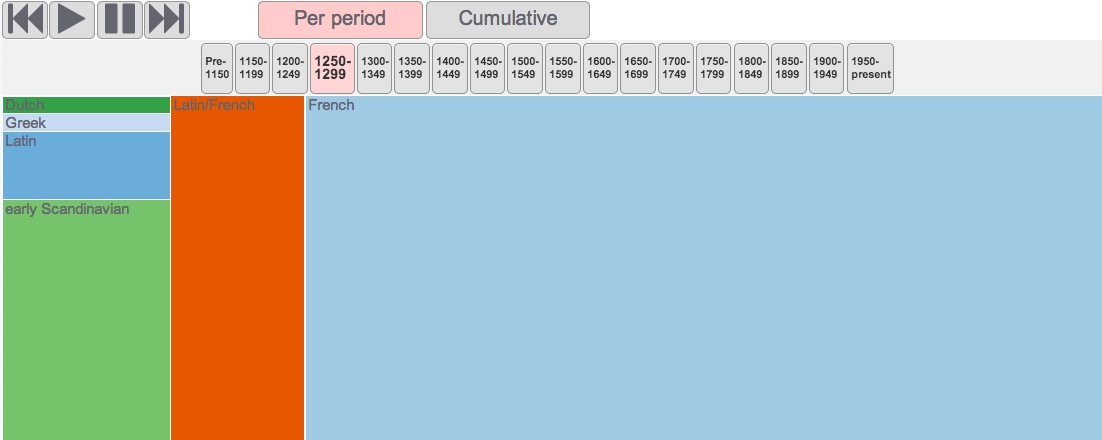
2014-03-05_13-25-39
Click image to access interactive tool and read complete blog post.
Source: OxfordWords Blog

If you switch to the “cumulative” view, then you can see how the total number of loanwords from each language has built up over time. Here the shifts from one 50-year period to another are rather less dramatic, but the long-term shifts are still very striking. You can see, for instance, how German, Spanish, and Italian all slowly come to greater prominence. You can see this very clearly if you select any start date and then press the “play” button. (If you would like to see the numbers behind the graphic, a selection of graphs and charts from Borrowed Words are available on our companion website.

Read the Complete Blog Post and Access the Interactive Tool

Filed under: Data Files, News

SHARE:

About Gary Price

Gary Price (gprice@gmail.com) is a librarian, writer, consultant, and frequent conference speaker based in the Washington D.C. metro area. He earned his MLIS degree from Wayne State University in Detroit. Price has won several awards including the SLA Innovations in Technology Award and Alumnus of the Year from the Wayne St. University Library and Information Science Program. From 2006-2009 he was Director of Online Information Services at Ask.com.

ADVERTISEMENT

Archives
Job Zone

ADVERTISEMENT

Related Infodocket Posts

ADVERTISEMENT

FOLLOW US ON X

Tweets by infoDOCKET

ADVERTISEMENT

This coverage is free for all visitors. Your support makes this possible.

This coverage is free for all visitors. Your support makes this possible.

Primary Sidebar

  • News
  • Reviews+
  • Technology
  • Programs+
  • Design
  • Leadership
  • People
  • COVID-19
  • Advocacy
  • Opinion
  • INFOdocket
  • Job Zone

Reviews+

  • Booklists
  • Prepub Alert
  • Book Pulse
  • Media
  • Readers' Advisory
  • Self-Published Books
  • Review Submissions
  • Review for LJ

Awards

  • Library of the Year
  • Librarian of the Year
  • Movers & Shakers 2022
  • Paralibrarian of the Year
  • Best Small Library
  • Marketer of the Year
  • All Awards Guidelines
  • Community Impact Prize

Resources

  • LJ Index/Star Libraries
  • Research
  • White Papers / Case Studies

Events & PD

  • Online Courses
  • In-Person Events
  • Virtual Events
  • Webcasts
  • About Us
  • Contact Us
  • Advertise
  • Subscribe
  • Media Inquiries
  • Newsletter Sign Up
  • Submit Features/News
  • Data Privacy
  • Terms of Use
  • Terms of Sale
  • FAQs
  • Careers at MSI


© 2026 Library Journal. All rights reserved.


© 2022 Library Journal. All rights reserved.