Open access (OA) and the broad sharing of research outputs has been empirically shown to accelerate scientific progress and benefit society and individuals at scale through improved health outcomes, socioeconomic mobility, and environmental well-being, to name a few. Academic research libraries, for their part, have made significant investments in opening up research and scholarship—particularly research conducted on their campuses and made available through journal subscriptions. Yet these investments are difficult to collect given their distribution across many budget lines, the lack of standardized reporting categories, and inconsistent data collection practices.
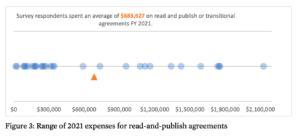
In May–June 2022 the Association of Research Libraries (ARL) surveyed its US-based academic research libraries to better understand OA expenses. The survey asked respondents to categorize expenses into six areas of investment: read-and-publish or transitional agreements, article processing charges (APC) or OA funds, non-APC-based OA publishing models, institutional repository services, OA journal hosting and publishing services, and open monographs.
Source: 10.29242/report.investmentsinopen2022
This ARL report provides a summary and analysis of the aggregate data from the survey, provides charts on institutional responses and averages, and discusses some outcomes and next steps.
Gary Price (gprice@gmail.com) is a librarian, writer, consultant, and frequent conference speaker based in the Washington D.C. metro area.
He earned his MLIS degree from Wayne State University in Detroit.
Price has won several awards including the SLA Innovations in Technology Award and Alumnus of the Year from the Wayne St. University Library and Information Science Program. From 2006-2009 he was Director of Online Information Services at Ask.com.


Open access (OA) and the broad sharing of research outputs has been empirically shown to accelerate scientific progress and benefit society and individuals at scale through improved health outcomes, socioeconomic mobility, and environmental well-being, to name a few. Academic research libraries, for their part, have made significant investments in opening up research and scholarship—particularly research conducted on their campuses and made available through journal subscriptions. Yet these investments are difficult to collect given their distribution across many budget lines, the lack of standardized reporting categories, and inconsistent data collection practices.