SUBSCRIBE
SUBSCRIBE
EXPLORE +
  • About infoDOCKET
  • Academic Libraries on LJ
  • Research on LJ
  • News on LJ
  • Skip to primary navigation
  • Skip to main content
  • Skip to primary sidebar
  • Libraries
    • Academic Libraries
    • Government Libraries
    • National Libraries
    • Public Libraries
  • Companies (Publishers/Vendors)
    • EBSCO
    • Elsevier
    • Ex Libris
    • Frontiers
    • Gale
    • PLOS
    • Scholastic
  • New Resources
    • Dashboards
    • Data Files
    • Digital Collections
    • Digital Preservation
    • Interactive Tools
    • Maps
    • Other
    • Podcasts
    • Productivity
  • New Research
    • Conference Presentations
    • Journal Articles
    • Lecture
    • New Issue
    • Reports
  • Topics
    • Archives & Special Collections
    • Associations & Organizations
    • Awards
    • Funding
    • Interviews
    • Jobs
    • Management & Leadership
    • News
    • Patrons & Users
    • Preservation
    • Profiles
    • Publishing
    • Roundup
    • Scholarly Communications
      • Open Access

May 30, 2022 by Gary Price

Journal Article: “Types of Errors Hiding in Google Scholar Data”

May 30, 2022 by Gary Price

The article linked below was recently published by the Journal of Medical Internet Research (JMIR).

Title

Types of Errors Hiding in Google Scholar Data

Author

Romy Sauvayre
Université Clermont Auvergne, France

Source

DOI

Abstract

Google Scholar (GS) is a free tool that may be used by researchers to analyze citations; find appropriate literature; or evaluate the quality of an author or a contender for tenure, promotion, a faculty position, funding, or research grants. GS has become a major bibliographic and citation database. For assessing the literature, databases, such as PubMed, PsycINFO, Scopus, and Web of Science, can be used in place of GS because they are more reliable. The aim of this study was to examine the accuracy of citation data collected from GS and provide a comprehensive description of the errors and miscounts identified. For this purpose, 281 documents that cited 2 specific works were retrieved via Publish or Perish software (PoP) and were examined.

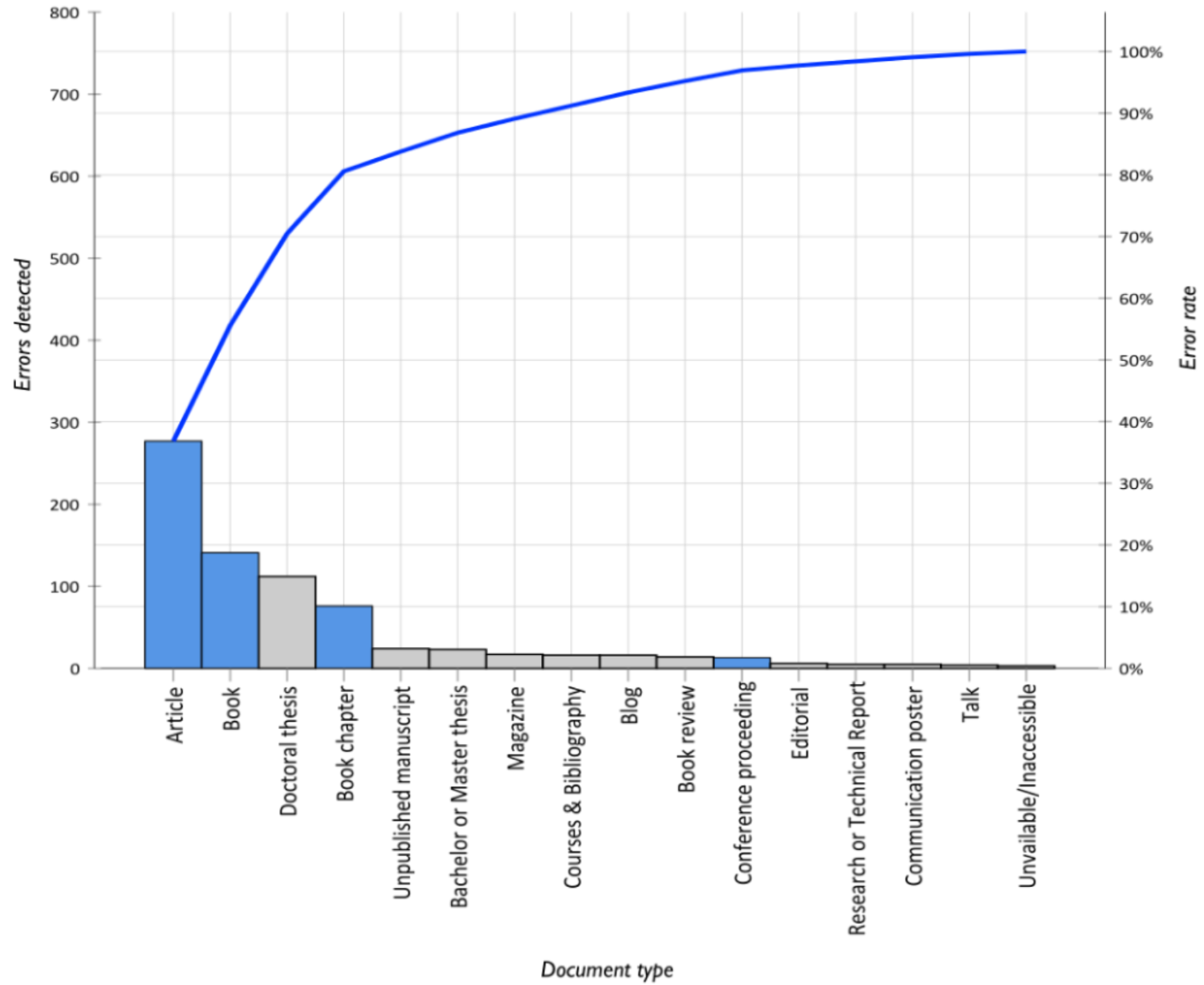
Figure 1. Pareto diagram. Sum of errors detected (N=755) as a function of document type. Light blue indicates academic publications, gray indicates nonacademic documents, and dark blue indicates cumulative sum curve of errors detected. Source: 10.2196/28354

This work studied the false-positive issue inherent in the analysis of neuroimaging data. The results revealed an unprecedented error rate, with 279 of 281 (99.3%) examined references containing at least one error. Nonacademic documents tended to contain more errors than academic publications (U=5117.0; P<.001).

This viewpoint article, based on a case study examining GS data accuracy, shows that GS data not only fail to be accurate but also potentially expose researchers, who would use these data without verification, to substantial biases in their analyses and results. Further work must be conducted to assess the consequences of using GS data extracted by PoP.

Direct to Full Text Article

Filed under: Data Files, Funding, News

SHARE:

About Gary Price

Gary Price (gprice@gmail.com) is a librarian, writer, consultant, and frequent conference speaker based in the Washington D.C. metro area. He earned his MLIS degree from Wayne State University in Detroit. Price has won several awards including the SLA Innovations in Technology Award and Alumnus of the Year from the Wayne St. University Library and Information Science Program. From 2006-2009 he was Director of Online Information Services at Ask.com.


ADVERTISEMENT

Archives

Job Zone

ADVERTISEMENT

Related Infodocket Posts

ADVERTISEMENT

FOLLOW US ON X

Tweets by infoDOCKET

ADVERTISEMENT

This coverage is free for all visitors. Your support makes this possible.

This coverage is free for all visitors. Your support makes this possible.

Primary Sidebar

  • News
  • Reviews+
  • Technology
  • Programs+
  • Design
  • Leadership
  • People
  • COVID-19
  • Advocacy
  • Opinion
  • INFOdocket
  • Job Zone

Reviews+

  • Booklists
  • Prepub Alert
  • Book Pulse
  • Media
  • Readers' Advisory
  • Self-Published Books
  • Review Submissions
  • Review for LJ

Awards

  • Library of the Year
  • Librarian of the Year
  • Movers & Shakers 2022
  • Paralibrarian of the Year
  • Best Small Library
  • Marketer of the Year
  • All Awards Guidelines
  • Community Impact Prize

Resources

  • LJ Index/Star Libraries
  • Research
  • White Papers / Case Studies

Events & PD

  • Online Courses
  • In-Person Events
  • Virtual Events
  • Webcasts
  • About Us
  • Contact Us
  • Advertise
  • Subscribe
  • Media Inquiries
  • Newsletter Sign Up
  • Submit Features/News
  • Data Privacy
  • Terms of Use
  • Terms of Sale
  • FAQs
  • Careers at MSI


© 2026 Library Journal. All rights reserved.


© 2022 Library Journal. All rights reserved.