Kennedy Assassination Bullets Preserved in Digital Form
From NIST:
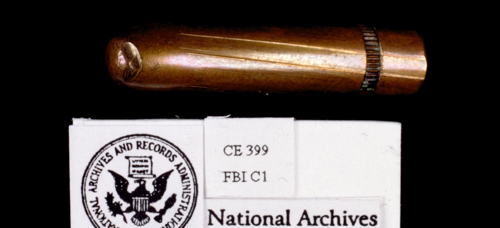
In the palm of his hand, Thomas Brian Renegar held two small metal objects that had changed the course of history. Twisted pieces of copper and lead, they were fragments of the bullet that ended the life of President John F. Kennedy on Nov. 22, 1963.
A physical scientist at the National Institute of Standards and Technology (NIST), Renegar was not yet born when the nation was robbed of the young, charismatic leader who fought for civil rights and set America on a course for the Moon. But he felt the weight of history. He picked up one of the fragments using rubber-tipped forceps and, with the care of a jeweler setting a stone, placed it into a housing beneath the lens of a 3D surface scanning microscope.
These artifacts are usually held at the National Archives. They were transported to NIST so that Renegar and the rest of the NIST ballistics team could scan them and produce digital replicas that are true down to the microscopic details.
Viewing the digital replicas on his computer screen, Renegar said, “It’s like they’re right there in front of you.” The National Archives plans to make the data available in its online catalog in early 2020.
Why do this, so many years after President Kennedy’s tragic death? The mission of the National Archives is to provide the public with access to artifacts such as these, and it receives many requests for access to them. This project will allow the Archives to release the 3D replicas to the public while the originals remain safely preserved in their temperature and humidity-controlled vault.
“The virtual artifacts are as close as possible to the real things,” said Martha Murphy, deputy director of government information services at the National Archives. “In some respects, they are better than the originals in that you can zoom in to see microscopic details,” she said.
Read the Complete Article, View Video (approx. 1150 words)
See Also: Preserving the Kennedy Assassination Bullets in Digital Form (via NIST)
Filed under: Archives and Special Collections, Data Files, Digital Preservation, News

About Gary Price
Gary Price (gprice@gmail.com) is a librarian, writer, consultant, and frequent conference speaker based in the Washington D.C. metro area. He earned his MLIS degree from Wayne State University in Detroit. Price has won several awards including the SLA Innovations in Technology Award and Alumnus of the Year from the Wayne St. University Library and Information Science Program. From 2006-2009 he was Director of Online Information Services at Ask.com.
ADVERTISEMENT
Archives
ADVERTISEMENT