

SUBSCRIBE
SUBSCRIBE
EXPLORE +
  • About infoDOCKET
  • Academic Libraries on LJ
  • Research on LJ
  • News on LJ
  • Skip to primary navigation
  • Skip to main content
  • Skip to primary sidebar
  • Libraries
    • Academic Libraries
    • Government Libraries
    • National Libraries
    • Public Libraries
  • Companies (Publishers/Vendors)
    • EBSCO
    • Elsevier
    • Ex Libris
    • Frontiers
    • Gale
    • PLOS
    • Scholastic
  • New Resources
    • Dashboards
    • Data Files
    • Digital Collections
    • Digital Preservation
    • Interactive Tools
    • Maps
    • Other
    • Podcasts
    • Productivity
  • New Research
    • Conference Presentations
    • Journal Articles
    • Lecture
    • New Issue
    • Reports
  • Topics
    • Archives & Special Collections
    • Associations & Organizations
    • Awards
    • Funding
    • Interviews
    • Jobs
    • Management & Leadership
    • News
    • Patrons & Users
    • Preservation
    • Profiles
    • Publishing
    • Roundup
    • Scholarly Communications
      • Open Access

April 12, 2019 by Gary Price

How Canadian Readers Discover and Obtain Books, New Data From BookNet Canada Leisure Study

April 12, 2019 by Gary Price

From a BookNet Canada Blog Post by Shimona Hirchberg:

Who are this year’s readers? The majority of readers surveyed identify as female, are partnered, are parents, and work full-time with a household income between $25,000 and $50,000. Most readers live in cities or urban areas (48%), followed by suburban areas (32%).

Over half of all readers have at least one child (53%) and 37% have children living at home. Adults living with partners make up 29% of readers, while 19% live alone, 8% live with a roommate(s), and 7% are empty nesters.

Almost a quarter of readers are between 25 and 34 years old (23%), closely followed by the 35- to 44-year-old age bracket (22%), and those 55 to 64 years old (20%).

[Clip]

How Canadian Readers Acquire Books

Where do readers acquire most of their books? Does it differ depending on the book format? Short answer: Yes.

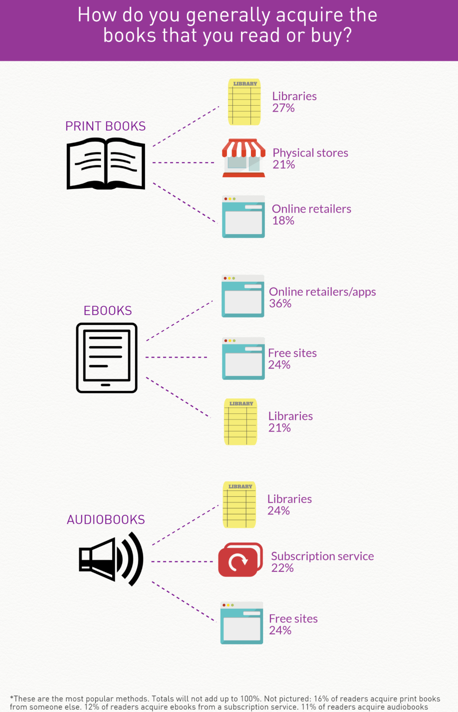
Longer answer: Readers mostly acquire print books from the library (27%), physical bookstores (21%), or an online retailer (18%). They also get books from “someone else” (16%) — maybe family, friends, or that coworker who keeps pushing A Game of Thrones on everyone.

Readers mostly acquire ebooks from an online retailer or app (36%), from a website offering free downloads (24%), the library (21%), or a subscription service (12%).

For audiobooks, readers mostly acquire them from the library (24%), a subscription service (22%), a website offering free downloads (18%), or an online retailer (11%).
Read the Complete Blog Post
Including data (and infographic) on how Canadians discovery books (by format). 

See Also: Canadians and Their Leisure Time: Leisure Study Part 1

Filed under: Data Files, Libraries, News

SHARE:

About Gary Price

Gary Price (gprice@gmail.com) is a librarian, writer, consultant, and frequent conference speaker based in the Washington D.C. metro area. He earned his MLIS degree from Wayne State University in Detroit. Price has won several awards including the SLA Innovations in Technology Award and Alumnus of the Year from the Wayne St. University Library and Information Science Program. From 2006-2009 he was Director of Online Information Services at Ask.com.

ADVERTISEMENT

Archives
Job Zone

ADVERTISEMENT

Related Infodocket Posts

ADVERTISEMENT

FOLLOW US ON X

Tweets by infoDOCKET

ADVERTISEMENT

This coverage is free for all visitors. Your support makes this possible.

This coverage is free for all visitors. Your support makes this possible.

Primary Sidebar

  • News
  • Reviews+
  • Technology
  • Programs+
  • Design
  • Leadership
  • People
  • COVID-19
  • Advocacy
  • Opinion
  • INFOdocket
  • Job Zone

Reviews+

  • Booklists
  • Prepub Alert
  • Book Pulse
  • Media
  • Readers' Advisory
  • Self-Published Books
  • Review Submissions
  • Review for LJ

Awards

  • Library of the Year
  • Librarian of the Year
  • Movers & Shakers 2022
  • Paralibrarian of the Year
  • Best Small Library
  • Marketer of the Year
  • All Awards Guidelines
  • Community Impact Prize

Resources

  • LJ Index/Star Libraries
  • Research
  • White Papers / Case Studies

Events & PD

  • Online Courses
  • In-Person Events
  • Virtual Events
  • Webcasts
  • About Us
  • Contact Us
  • Advertise
  • Subscribe
  • Media Inquiries
  • Newsletter Sign Up
  • Submit Features/News
  • Data Privacy
  • Terms of Use
  • Terms of Sale
  • FAQs
  • Careers at MSI


© 2026 Library Journal. All rights reserved.


© 2022 Library Journal. All rights reserved.