The internet is made up of thousands of public and private networks around the world. And since it came to life in 1984, more than 4.7 zettabytes of IP traffic have flowed across it. That’s the same as all the movies ever made crossing global IP networks in less than a minute.
Yet the new Visual Networking Index (VNI) by Cisco predicts that is just the beginning. By 2022, more IP traffic will cross global networks than in all prior ‘internet years’ combined up to the end of 2016. In other words, more traffic will be created in 2022 than in the 32 years since the internet started. Where will that traffic come from? All of us, our machines and the way we use the internet. By 2022, 60 percent of the global population will be internet users. More than 28 billion devices and connections will be online. And video will make up 82 percent of all IP traffic.
[Clip] Source: Cisco (https://newsroom.cisco.com/feature-content?type=webcontent&articleId=1955660) Key Predictions For 2022
Cisco’s VNI looks at the impact that users, devices and other trends will have on global IP networks over a five-year period. From 2017 to 2022, Cisco predicts:
Global IP traffic will more than triple
Global IP traffic is expected to reach 396 exabytes per month by 2022, up from 122 exabytes per month in 2017. That’s 4.8 zettabytes of traffic per year by 2022.
By 2022, the busiest hour of internet traffic will be six times more active than the average. Busy hour internet traffic will grow by nearly five times (37 percent CAGR) from 2017 to 2022, reaching 7.2 petabytes [1] per second by 2022. In comparison, average internet traffic will grow by nearly four times (30 percent CAGR) over the same period to reach 1 petabyte by 2022.
Global internet users will make up 60 percent of the world’s population
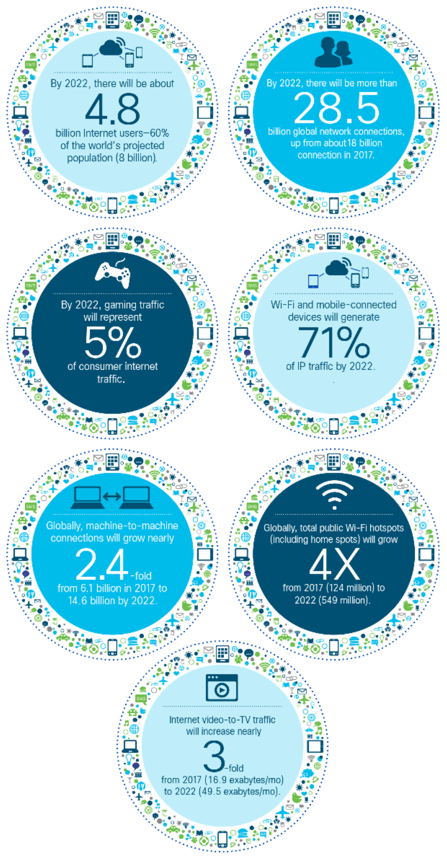
There will be 4.8 billion internet users by 2022. That’s up from 3.4 billion in 2017 or 45 percent of the world’s population.
Global networked devices and connections will reach 28.5 billion
By 2022, there will be 28.5 billion fixed and mobile personal devices and connections, up from 18 billion in 2017—or 3.6 networked devices/connections per person, from 2.4 per person.
More than half of all devices and connections will be machine-to-machine by 2022, up from 34 percent in 2017. That’s 14.6 billion connections from smart speakers, fixtures, devices and everything else, up from 6.1 billion.
Global broadband, Wi-Fi and mobile speeds will double or more
Average global fixed broadband speeds will nearly double from 39.0 Mbps to 75.4 Mbps.
Average global Wi-Fi connection speeds will more than double from 24.4 Mbps to 54.0 Mbps.
Average global mobile connection speeds will more than triple from 8.7 Mbps to 28.5 Mbps.
Video, gaming and multimedia will make up more than 85 percent of all traffic
IP video traffic will quadruple by 2022. As a result, it will make up an even larger percentage of total IP traffic than before—up to 82 percent from 75 percent.
Gaming traffic is expected to grow nine-fold from 2017 to 2022. It will represent four percent of overall IP traffic in 2022.
Virtual and augmented reality traffic will skyrocket as more consumers and businesses use the technologies. By 2022, virtual and augmented reality traffic will reach 4.02 exabytes/month, up from 0.33 exabytes/month in 2017.
Regional IP traffic growth details (2017 – 2022)
APAC: 173 exabytes/month by 2022, 32 percent CAGR, four-times growth
North America: 108 exabytes/month by 2022, 21 percent CAGR, three-times growth
Western Europe: 50 exabytes/month 2022, 22 percent CAGR, three-times growth
Central & Eastern Europe: 25 exabytes/month by 2022, 26 percent CAGR, three-times growth
Middle East and Africa: 21 exabytes/month by 2022, 41 percent CAGR, six-times growth
Latin America: 19 exabytes/month by 2022, 21 percent CAGR, three-times growth
Gary Price (gprice@gmail.com) is a librarian, writer, consultant, and frequent conference speaker based in the Washington D.C. metro area.
He earned his MLIS degree from Wayne State University in Detroit.
Price has won several awards including the SLA Innovations in Technology Award and Alumnus of the Year from the Wayne St. University Library and Information Science Program. From 2006-2009 he was Director of Online Information Services at Ask.com.