

Research Tools: Population Research Bureau Releases 2018 World Population Data Sheet and Resources
From the Population Research Bureau (PRB):
The world population will reach 9.9 billion by 2050, up 2.3 billion or 29 percent from an estimated 7.6 billion people now, according to projections by Population Reference Bureau (PRB) included in the 2018 World Population Data Sheet.
PRB estimates the 2018 worldwide total fertility rate (TFR, or average births per woman over their lifetime) at 2.4; the global TFR has been declining for the past few decades but remains high enough to generate continued population growth. The three countries with the highest TFRs are Niger (7.2), Chad (6.4), and the Democratic Republic of the Congo (6.3), while the lowest TFRs are in South Korea (1.1), Singapore (1.2), and Taiwan (1.2).
PRB projects Africa’s population will more than double to 2.6 billion by 2050 and account for 58 percent of the global population increase by that date. The number of people in Asia is projected to rise about 717 million to 5.3 billion, while Europe (which includes all of Russia) would see a decline in population from 746 million to 730 million. The Americas population is projected to increase from 1 billion now to 1.2 billion, and Oceania (which includes Australia and New Zealand) is seen rising from 41 million to 64 million.
PRB has produced its widely referenced World Population Data Sheet (www.worldpopdata.org) annually since 1962. This year’s edition provides the latest data on 26 key population, health, and environment indicators for the world, major regions, and more than 200 countries and territories.
Below are some highlights from PRB’s midcentury population projections in the 2018 World Population Data Sheet:
The population of 26 countries, nearly all in Africa, will at least double. Niger in West Africa will see its population nearly triple.
A total of 38 countries will have smaller populations in 2050 than in 2018. China will register the largest numerical population decrease―about 50 million―followed by Japan at 25 million and Russia at 9.4 million. Romania will see the largest percentage decline in population (23 percent).
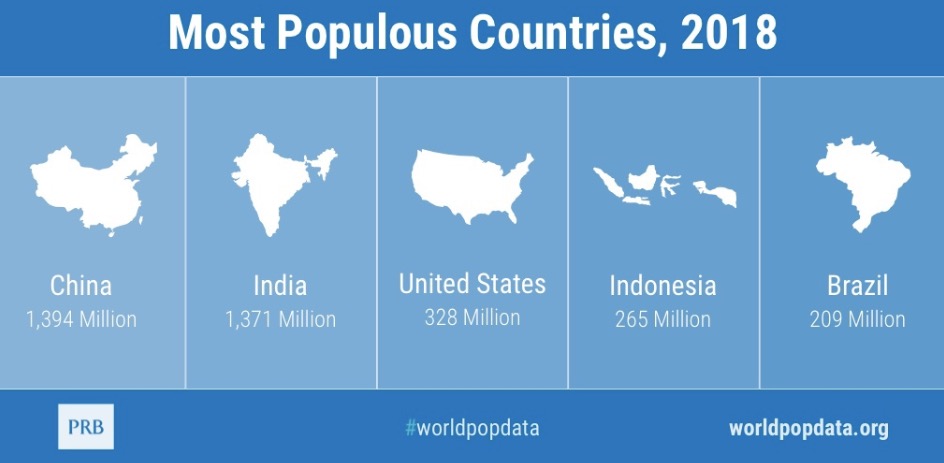
The population of the United States will reach 390 million, up from 328 million in 2018.
China’s population will decrease by about 50 million from its current size to 1.34 billion. India will supplant China as the world’s most populous country with 1.68 billion people.
Nigeria will become the third most populous country as its population rises to 411 million, up 109 percent from 2018. Nigeria is currently the seventh most populous country.
Resources
Direct to Full Text Data Sheet
20 pages; PDF.
Direct to Summary/Highlights
Direct to Interactive Database: WorldPopData
Direct to Social Media Toolkit (Downloadable Key Charts/Graphs)
Filed under: Data Files, News

About Gary Price
Gary Price (gprice@gmail.com) is a librarian, writer, consultant, and frequent conference speaker based in the Washington D.C. metro area. He earned his MLIS degree from Wayne State University in Detroit. Price has won several awards including the SLA Innovations in Technology Award and Alumnus of the Year from the Wayne St. University Library and Information Science Program. From 2006-2009 he was Director of Online Information Services at Ask.com.
ADVERTISEMENT
Archives

ADVERTISEMENT