International Literacy Association (ILA) Releases “2018 What’s Hot in Literacy” Report
From the International Literacy Association:
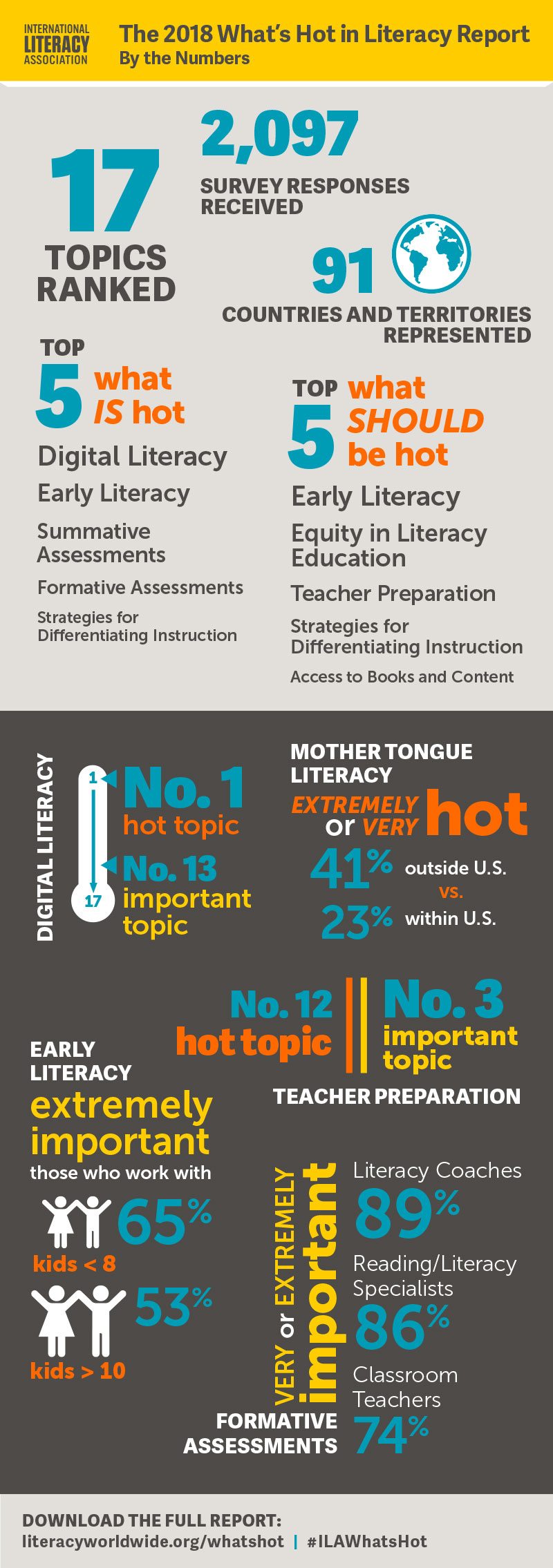
The ILA 2018 What’s Hot in Literacy Report provides a snapshot of what 2,097 literacy professionals from 91 countries and territories deem the most critical topics to advancing literacy worldwide. The survey asked respondents to rate 17 literacy-related topics in terms of what’s hot and what’s important.
Topping the hot list for the second year in a row: Digital Literacy, a topic that dropped from No. 8 in 2017 to No. 13 in terms of importance.
On the flip side, topics such as Access to Books and Content, Mother Tongue Literacy and Equity in Literacy Education ranked significantly higher in importance than they did heat.
These gaps reflect the challenges of teaching in today’s world, such as a rise in racial, ethnic, and cultural diversity; a growing number of English learners; and an unequitable distribution of resources in classrooms— and illustrate a growing number of unmet needs in these areas.
Top Takeaways
1. Early Literacy takes the No. 1 spot as the most important topic for the second year in a row. It is the most valued topic among respondents, with 87% ranking it extremely or very important, compared with 57% ranking it extremely or very hot.
2. Family Engagement and Community Partnerships are more important than they are hot. Both topics should be getting more attention. In fact, Family Engagement has the second largest gap between hot and important ratings among the topics.
3. More focus is needed on Teacher Preparation. It ranks No. 3 among important topics but falls to No. 12 in terms of how much attention it receives— representing the largest gap in the report.
4. Equity in Literacy Education is a critical global issue. Although 86% of respondents feel it is extremely or very important, only 50% rate it extremely or very hot. It’s the No. 2 most important topic in developing countries and the United States and No. 1 in other developed countries.
5. Strategies for Differentiating Instruction ranks among the top five hottest and most important topics. It accompanies only Early Literacy as an issue on both top five lists.
6. Access to Books and Content again ranks as more important than hot. The issue comes in only at No. 11 among hot topics but rises to No. 5 in importance.
7. Mother Tongue Literacy is not as hot or important to respondents in the United States as it is to respondents in other countries. The topic is among those with the greatest gaps, but U.S. survey takers rate it 23% extremely or very hot (compared with 41%) and 62% extremely or very important (compared with 71%).
8. Digital Literacy is not nearly as important to our respondents as other topics. It ranks No. 1 among all hot topics but comes in at No. 13 in terms of importance.
9. Formative Assessments are valued much more than Summative Assessments. Summative Assessments falls last at No. 17 in importance, but Formative Assessments ranks No. 8.
10. Reading/literacy specialists and literacy/instructional coaches value Formative Assessments more than classroom teachers do. It surprised us that 74% of classroom teachers rate the topic extremely or very important, whereas 86% of reading/literacy specialists and 89% of literacy/instructional coaches do.
Direct to Full Text Report
24 pages; PDF.
Additional Resources
Filed under: News

About Gary Price
Gary Price (gprice@gmail.com) is a librarian, writer, consultant, and frequent conference speaker based in the Washington D.C. metro area. He earned his MLIS degree from Wayne State University in Detroit. Price has won several awards including the SLA Innovations in Technology Award and Alumnus of the Year from the Wayne St. University Library and Information Science Program. From 2006-2009 he was Director of Online Information Services at Ask.com.
ADVERTISEMENT
Archives
ADVERTISEMENT