UPDATE August 7 An interview with Jason Priem (one of the study’s co-authors) was published today by The Scientist. You can read the complete interview “Open Access On the Rise: Study” on TheScientist.com
—
A new preprint posted to PeerJ today by several well-known researchers. The dataset is also available. Title The State of OA: A Large-Scale Analysis of the Prevalence and Impact Of Open Access Articles Authors
Heather Piwowar Impactstory
Jason Priem Impactstory
Vincent Larivière Université de Montréal CIRST, Université du Québec à Montréal
Juan Pablo Alperine Simon Fraser University
Public Knowledge Project
Lisa Matthias Independent Scholar
Bree Norlander University of Washington
Ashley Farley University of Washington
Jevin West University of Washington
Stefanie Haustein University of Ottawa CIRST, Université du Québec à Montréal Source
PeerJ
doi: 10.7287/peerj.preprints.3119v1 Abstract
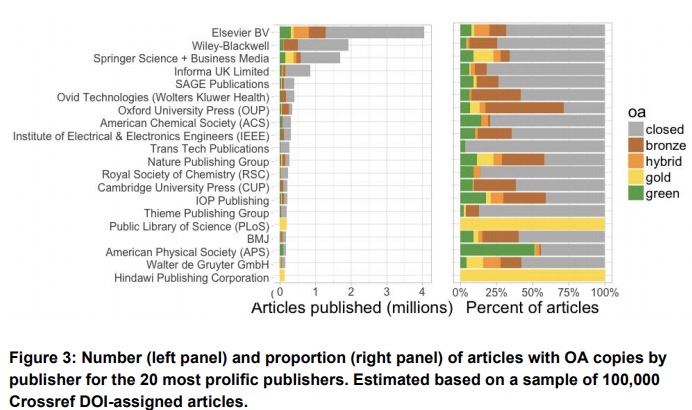
Despite growing interest in Open Access (OA) to scholarly literature, there is an unmet need for large-scale, up-to-date, and reproducible studies assessing the prevalence and characteristics of OA. We address this need using oaDOI, an open online service that determines OA status for 67 million articles.
We use three samples, each of 100,000 articles, to investigate OA in three populations: 1) all journal articles assigned a Crossref DOI, 2) recent journal articles indexed in Web of Science, and 3) articles viewed by users of Unpaywall, an open-source browser extension that lets users find OA articles using oaDOI. Source: The State of OA: A large-scale analysis of the prevalence and impact of Open Access articles (Preprint); August 2, 2017.
We estimate that at least 28% of the scholarly literature is OA (19M in total) and that this proportion is growing, driven particularly by growth in Gold and Hybrid. The most recent year analyzed (2015) also has the highest percentage of OA (45%). Because of this growth, and the fact that readers disproportionately access newer articles, we find that Unpaywall users encounter OA quite frequently: 47% of articles they view are OA. Notably, the most common mechanism for OA is not Gold, Green, or Hybrid OA, but rather an under-discussed category we dub Bronze: articles made free-to-read on the publisher website, without an explicit Open license.
We also examine the citation impact of OA articles, corroborating the so-called open-access citation advantage: accounting for age and discipline, OA articles receive 18% more citations than average, an effect driven primarily by Green and Hybrid OA. We encourage further research using the free oaDOI service, as a way to inform OA policy and practice.
As part of this new relationship, Impactstory is developing a free service, in conjunction with PKP, to deliver document-level metrics by leveraging the recently announced Crossref Event Data service. This new service will provide various measures of online activity including number of times a document has been mentioned on other platforms (e.g., Twitter, Wikipedia, etc); number of mentions by date; as well as any available information of each mention.
Concurrently, PKP will develop a new OJS plugin that will access the new service and display document usage information on the abstract page of any OJS-based journal.
Gary Price (gprice@gmail.com) is a librarian, writer, consultant, and frequent conference speaker based in the Washington D.C. metro area.
He earned his MLIS degree from Wayne State University in Detroit.
Price has won several awards including the SLA Innovations in Technology Award and Alumnus of the Year from the Wayne St. University Library and Information Science Program. From 2006-2009 he was Director of Online Information Services at Ask.com.