

New Report: “How Americans Encounter, Recall and Act Upon Digital News”
The findings below are part of a research report released today by the Pew Research Center, How Americans Encounter, Recall and Act Upon Digital News.
From the Report:
Anyone who wants to understand today’s news environment faces a challenge: How to discern the nuances of digital news habits when Americans’ attention spans are fractured, human memory is naturally limited and news comes at them every which way.
To tackle this complex question, Pew Research Center, in association with the John S. and James L. Knight Foundation, took on the unusual task of staying in touch with more than 2,000 U.S. adults who get at least some news online over the course of a week. The study ran from Feb. 24 to March 1, 2016. Respondents were asked twice a day whether they got news online within the past two hours and, if so, were asked about their experience with that news.
[Clip]
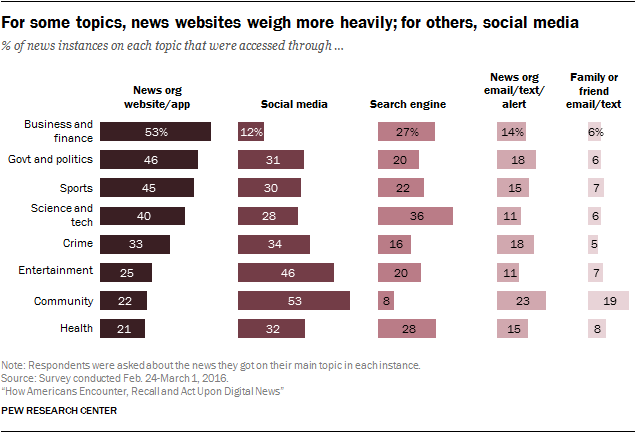
While there are a number of pathways Americans use to get news online, two in this study stand out as the most common: social media and direct visits to news organizations’ websites. When asked how they arrived at news content in their most recent web interaction, online news consumers were about equally likely to get news by going directly to a news website (36% of the times they got news, on average) as getting it through social media (35%). They were less likely to access news through emails, text messages or search engines. And most people favored one pathway over another. Nearly two-thirds (65%) of online news consumers had one preferred pathway for getting most of their online news.
The study also sheds light on whether people are actually aware of the sources of news they consume – a question all the more relevant in light of the prevalence of fabricated news stories during the final weeks of the 2016 election.
It reveals that when consumers click on a link to get to news, they can often recall the news source’s name. Individuals who said they followed a link to a news story were asked if they could write down the name of the news outlet they landed on. On average, they provided a name 56% of the time. But they were far more able to do so when that link came directly from a news organization – such as through an email or text alert from the news organization itself – than when it came from social media or an email or text from a friend. It was also the case that 10% of consumers, when asked to name the source of the news, wrote in “Facebook” as a specific news outlet.


Direct to Full Text Report ||| PDF Version (41 pages; PDF)
Filed under: News

About Gary Price
Gary Price (gprice@gmail.com) is a librarian, writer, consultant, and frequent conference speaker based in the Washington D.C. metro area. He earned his MLIS degree from Wayne State University in Detroit. Price has won several awards including the SLA Innovations in Technology Award and Alumnus of the Year from the Wayne St. University Library and Information Science Program. From 2006-2009 he was Director of Online Information Services at Ask.com.
ADVERTISEMENT
Archives

ADVERTISEMENT